Poly Yarn plays a central role in modern textile manufacturing, especially in polyester-based fabrics. Among the different polyester yarn forms, POY (Partially Oriented Yarn) is one of the most widely used intermediates due to its flexibility, processability, and cost efficiency. This article provides a clear explanation of POY poly yarn, focusing on its structure, production method, performance characteristics, and role in polyester textile manufacturing.
Understanding POY (Poly Yarn)
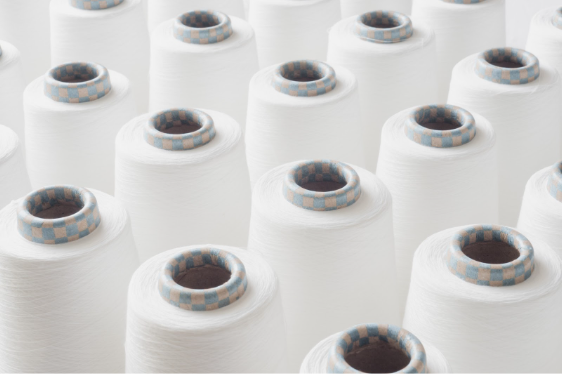
POY, or Partially Oriented Yarn, is a type of Poly Yarn produced from polyester polymer that has been partially stretched during spinning. This partial orientation gives the yarn moderate strength and elongation, making it unsuitable for direct end-use but ideal as a base yarn for further texturizing or drawing processes.
POY is mainly used as a feedstock for manufacturing DTY (Draw Textured Yarn) and, in some cases, FDY (Fully Drawn Yarn).
Raw Materials Used in Poly Yarn Production
Poly yarn is made from polyester polymer, which is derived from petrochemical sources. The primary raw materials include purified terephthalic acid (PTA) or dimethyl terephthalate (DMT), combined with monoethylene glycol (MEG). These materials are polymerized to form polyethylene terephthalate (PET), the base polymer used to produce polyester yarns.
|
PTA/DMT (Polyester acid component) |
+
↓ |
MEG
(Reacts with PTA/DMT to form polyester polymer) |
|
PET Polymer Chips (Polyethylene Terephthalate – Base polymer) ↓ |
||
|
Melt Spinning (Filament extrusion & Partial drawing) ↓ |
||
| Partially Oriented Yarn | ||
Manufacturing Process of POY Poly Yarn
The production of POY involves melt spinning technology. Polyester polymer chips are melted and extruded through spinnerets to form continuous filaments. These filaments are then cooled and partially drawn at controlled speeds to achieve limited molecular orientation.
Unlike fully drawn yarns, POY retains higher elongation and lower crystallinity, which allows it to be further processed into textured or drawn yarns.
Key Properties of POY Poly Yarn
POY Poly Yarn has a balance of strength and flexibility that makes it suitable for downstream processing. Key properties include:
- Moderate tensile strength
- High elongation
- Uniform filament structure
- Smooth surface finish
- Consistent dye uptake after texturizing
These properties allow POY to perform efficiently during drawing and texturizing operations without filament breakage. Poly yarns are available in different forms depending on their level of orientation and processing stage. Among these, POY occupies an intermediate position, with properties that clearly distinguish it from fully drawn and textured polyester yarns. Understanding these differences helps in selecting the right yarn type for specific textile processes.
Also read: Differences between Partially Oriented Yarn (POY) vs Fully Drawn Yarn (FDY)
Major Types of Poly Yarn Used in Textiles
In the textile industry, poly yarn is classified based on processing level and end use:
- POY (Partially Oriented Yarn): Semi-finished yarn used for further processing
- FDY (Fully Drawn Yarn): Fully oriented yarn used directly in weaving or knitting
- DTY (Draw Textured Yarn): Textured yarn with elasticity and bulk
- ATY (Air Textured Yarn): Yarn with a spun-like appearance
Among these, POY serves as the primary intermediate material. Aymsyntex offers POY in a wide denier range, typically from 75 to 500, designed for downstream texturizing and drawing applications.
Common Applications of POY Poly Yarn
POY Poly Yarn is not typically used directly in finished fabrics. Instead, it is widely used for:
- Manufacturing DTY yarns
- Producing textured and stretch fabrics
- Making home textile yarns after processing
- Industrial yarn applications after drawing
Its adaptability makes it essential in large-scale polyester yarn production. After further processing into usable polyester yarn forms, POY-based yarns are widely used in home textile products such as curtains, upholstery fabrics, and furnishing materials.
Refer: Our yarns for home textiles
POY vs Other Polyester Yarns
POY differs from FDY and DTY in orientation and usability. POY is partially drawn, FDY is fully drawn and ready for use, while DTY is textured and elastic. POY has higher elongation than FDY and lower bulk than DTY. This makes POY unsuitable for direct fabric formation but ideal for further processing.
Suitability of POY Poly Yarn for Textiles
POY Poly Yarn is suitable for textile production only after additional processing. Once converted into DTY or FDY, it becomes suitable for apparel fabrics, upholstery, curtains, and other textile applications.
Advantages of POY Poly Yarn
- Excellent process flexibility
- Cost-effective for bulk production
- Uniform quality and consistency
- Suitable for multiple downstream yarn types
- High production efficiency
These advantages make POY a preferred choice for yarn manufacturers.
Limitations of POY Poly Yarn
- Not suitable for direct weaving or knitting
- Requires additional processing
- Lower strength compared to FDY
- Limited end-use in raw form
Understanding these limitations is essential when selecting yarn types.
Selecting the Right POY Poly Yarn
When selecting POY Poly Yarn, factors such as denier, filament count, intended downstream process, and fabric application should be taken into account. Consistency in quality and compatibility with texturizing equipment are critical for optimal performance.