Cabled Yarns

Cabled Yarns: Enhancing Strength, Durability, and Performance in Industrial Textiles

Cabled yarns are widely used in textile and industrial manufacturing where higher strength, durability, and structural stability are required. By combining multiple plied yarns into a single, balanced structure, cabled yarns provide improved mechanical performance compared to standard yarn constructions. This makes them suitable for demanding applications such as ropes, carpets, industrial fabrics, and technical…

Read More
Best Yarn for Carpets

Best Yarn for Carpets: Performance, Cost, and Industrial Considerations

What Are Carpet Yarns? Carpet yarns are specialized yarns engineered for floor-covering applications such as carpets, rugs, and mats. Unlike apparel yarns, they are designed to withstand continuous foot traffic, mechanical stress, and environmental exposure while maintaining appearance and structure. Most modern carpet yarns are synthetic and produced in continuous filament form, particularly Bulked Continuous…

Read More
Polypropylene Yarns in Industrial Textiles

Polypropylene Yarns in Industrial Textiles: Strength, Durability, and Applications

What are Polypropylene Yarns? Polypropylene yarns are synthetic yarns manufactured from polypropylene polymers, designed to deliver high performance in demanding industrial environments. These yarns are produced through extrusion processes, where molten polymer is converted into continuous filaments or bulked yarn structures. Known for their low density, high durability, and resistance to chemicals and moisture, polypropylene…

Read More
Drawn Textured Yarn

Drawn Textured Yarn: Properties and Applications in Modern Textile Manufacturing

What is Drawn Textured Yarn? Drawn Textured Yarn (DTY) is a type of filament yarn that is processed through drawing and texturising to enhance its physical properties. DTY is typically made from polyester or nylon. It is produced by stretching partially oriented yarn (POY) and texturising it simultaneously using heat and a false-twist process. This…

Read More

What Is Textured Yarn? Texturing in Textile, Types, Uses & Differences

Textured yarn is widely used in modern textile manufacturing where fabric comfort, bulk, and functional performance are required. By modifying the structure of smooth synthetic filaments, manufacturers are able to improve how fabrics feel, behave, and perform in end-use applications. This article covers textured yarn, texturing in textiles, and key differences from non-textured yarns.  What…

Read More

Difference Between Nylon and Polyester: Properties, Uses & Which Is Better for Carpets?

When comparing nylon vs polyester, the discussion often becomes too generic. In the carpet and floor-covering industry, however, the comparison must be BCF-specific (Bulked Continuous Filament) and focused on end-use performance, not apparel. This article explains the difference between nylon and polyester BCF yarns, strictly from a carpet and flooring application perspective, in line with…

Read More

What Is POY (Poly Yarn)? Uses, Properties, Types & Differences

Poly Yarn plays a central role in modern textile manufacturing, especially in polyester-based fabrics. Among the different polyester yarn forms, POY (Partially Oriented Yarn) is one of the most widely used intermediates due to its flexibility, processability, and cost efficiency. This article provides a clear explanation of POY poly yarn, focusing on its structure, production…

Read More
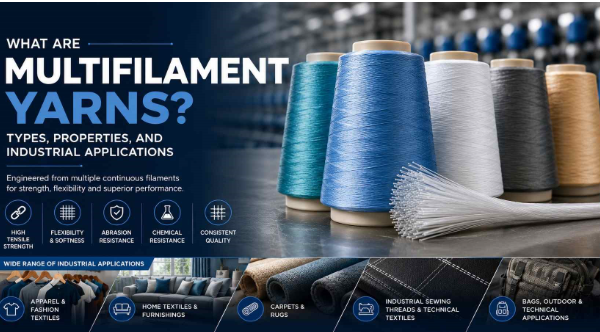
What Are Multifilament Yarns?

A Complete Guide to Polyester & Nylon Multifilament Yarn

If you’ve ever wondered what makes fabrics strong, stretchy, and durable, the answer often lies in multifilament yarns. These fine, flexible fibers play a huge role in industries like textiles, sportswear, automotive, and even medical applications. In this guide, we’ll explore what multifilament yarns are, how polyester and nylon multifilament yarns compare, and their various…

Read More