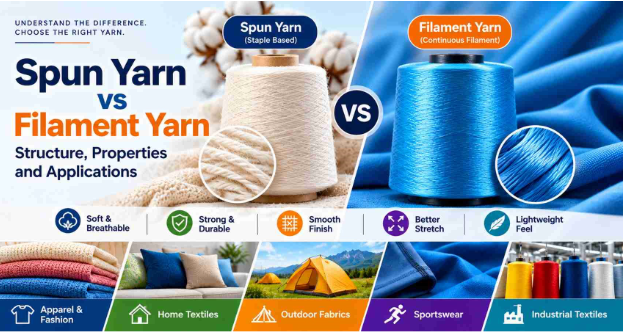
Yarn used in apparel, home textiles, and industrial fabrics are produced using two main approach spinning short, discontinuous fibres together, or extruding a continuous synthetic filament. This single distinction, between spun yarn and filament yarn, shapes nearly everything that follows in a fabric’s performance, including its surface feel, its strength, its tendency to pill, and its cost.
Understanding the difference between spun and filament yarn matters for manufacturers and procurement teams evaluating yarn options for a new fabric development project, since the two yarn types are not interchangeable substitutes but distinct structures suited to different fabric goals. This article explains what spun yarn and filament yarn are, how each is produced, where they differ in structure and performance, what spun filament yarn is, and how to decide which one fits a given application.
What Is Spun Yarn?
Spun yarn is produced by twisting together a mass of short, discontinuous fibres, known as staple fibres, into a single continuous strand. These staple fibres can be natural, such as cotton or wool, or manufactured, such as staple-cut polyester or nylon fibre, and the spinning process aligns and twists them together so that friction between the overlapping fibre ends holds the yarn together under tension.
Because spun yarn is built from many short fibre ends rather than one continuous strand, its surface is inherently textured, with countless fibre ends and loops projecting slightly from the yarn body. This structure is what gives spun yarn its characteristic soft, slightly fuzzy surface and the breathable, natural-feeling hand that many woven and knitted fabrics are valued for. Spun yarn is typically specified by yarn count, fibre composition, and twist level, with these variables together determining its strength, evenness, and surface character.
What Is Filament Yarn?
Filament yarn, by contrast, is produced by extruding a synthetic polymer melt through a spinneret to form one or more continuous filaments that run the full length of the yarn without a break. Because there are no fibre ends along the yarn’s length, other than at the very start and end of the package, filament yarn has a smooth, uniform surface and a more consistent diameter than spun yarn.
This continuous, smooth structure generally gives filament yarn a lustrous appearance and a firmer, more defined fabric surface compared with the textured softness of spun yarn. Filament yarn is typically specified by denier, filament count, and polymer type, and can be produced as flat, untextured yarn or as textured yarn such as DTY, depending on whether bulk and stretch are required for the intended fabric.
How Spun and Filament Yarn Are Made
The manufacturing routes behind spun yarn and filament yarn are fundamentally different processes, and this difference in origin is the root cause of nearly every performance difference discussed later in this article.
Spinning short staple fibres
Spun yarn manufacturing begins with staple fibre, which is cleaned, carded, and drawn into a loose, aligned rope of fibres before being twisted on a spinning frame to lock the fibres together into a cohesive yarn. The degree of twist applied directly affects the yarn’s strength and surface smoothness: a higher twist generally produces a stronger, smoother spun yarn, while a lower twist produces a softer, bulkier yarn with more surface fuzz. Because this process relies on mechanically interlocking short fibre ends, spun yarn manufacturing is inherently more variable than filament extrusion, which is why evenness and strength testing are important quality checks in spun yarn production.
Extruding continuous filaments
Filament yarn manufacturing begins with polymer chips that are melted and extruded through a spinneret, a plate with fine holes that shapes the molten polymer into continuous filaments as it cools and solidifies. These filaments are then drawn to align their molecular structure, which develops the yarn’s final strength, and may be combined into single or multiple filament bundles or further textured, depending on the target yarn type. Because this process produces one continuous strand rather than joining short fibres, filament yarn manufacturing generally achieves greater uniformity and fewer weak points along its length compared with spun yarn.
Also Read: What is Polyester Spun Yarn?
Difference Between Spun Yarn and Filament Yarn
Spun yarn and filament yarn differ in structure from the moment they are formed, and that structural difference carries through to how each performs in a finished fabric.
Structure and appearance
Spun yarn’s generally has more textured surface because it is made from short fiber , while filament yarn is made by single or multiple continuous strands give it a smooth surface and, depending on whether it is flat or textured, a more lustrous appearance.
Feel and comfort
The fibre ends projecting from spun yarn’s surface trap air and create a softer, more breathable hand-feel, which is part of why spun yarn is closely associated with the comfort profile of natural-fibre fabrics. Filament yarn’s smooth, continuous surface generally feels firmer and can feel less breathable against the skin unless specifically engineered or blended for comfort, though this varies with denier, filament count, and fabric construction.
Strength and pilling
Because filament yarn’s continuous strands are not held together by friction between short fibre ends, it is generally less prone to pilling, the surface balling caused by loose fibre ends tangling together, than spun yarn, whose protruding fibre ends are the direct cause of pilling over repeated wear and abrasion. Filament yarn can also offer higher tensile strength relative to weight in many cases, since there are no fibre-to-fibre joints along its length, though actual strength comparisons depend on the specific fibre or polymer, yarn count or denier, and twist or orientation level involved.
Cost
Spun yarn production generally involves more processing stages, carding, drawing, and spinning, which can add cost depending on fibre type and yarn count, while filament yarn production can be comparatively more direct for a given polymer and denier, though overall cost comparisons depend heavily on the specific fibre or polymer sourced, process efficiency, and market conditions rather than structure alone. Buyers should compare landed yarn cost for their specific specification rather than assuming one yarn type is categorically cheaper than the other.
Also Read: Key Characteristics of the Polyester Filament Yarn
What Is Spun Filament Yarn?
Spun filament yarn generally refers to a yarn construction that combines spun and filament elements, most commonly as a core-spun yarn, where a continuous filament core, often polyester, is wrapped with staple fibres spun around it. This construction is designed to combine the strength and consistency of a filament core with the soft, breathable surface character of spun fibre, giving manufacturers a way to access benefits from both yarn structures in a single yarn. For a closer look at this construction, see AYM Syntex’s guide on core spun yarns and their applications and characteristics.
Spun filament, or core-spun, yarn is typically specified by core filament denier, sheath fibre composition, and overall yarn count, and is commonly used where a fabric needs the surface comfort of spun yarn alongside strength or stretch characteristics that pure spun yarn cannot provide on its own.
When to Use Spun Yarn
Spun yarn is generally the appropriate choice when a fabric’s priority is a soft, breathable, natural-feeling surface, such as in woven shirting, knitwear, and home textile fabrics where comfort against the skin matters more than maximum strength or a lustrous finish. It is also commonly selected when the intended fibre, such as cotton, wool, or staple-cut recycled polyester, is only available or practical in staple form, making spun processing the natural manufacturing route. Applications across apparel and fashion and home-textile fabrics frequently rely on spun yarn for this reason.
When to Use Filament Yarn
Filament yarn is generally the better fit when a fabric calls for a smooth, lustrous surface, high strength relative to weight, or resistance to pilling, such as in linings, technical fabrics, and sewing threads where consistent strength along the yarn’s length is a priority. Industrial and technical applications, including industrial threads and yarns, frequently favour filament yarn for this reason, particularly where seam strength and abrasion resistance during stitching or end use are critical performance factors. For buyers evaluating sewing thread specifically, AYM Syntex’s guide on how to choose sewing threads outlines how filament-based thread construction supports stitch performance.
Conclusion
Spun yarn and filament yarn represent two fundamentally different routes to building a yarn, one built from twisted short staple fibres and the other from a continuous extruded strand, and that structural difference drives nearly every practical distinction between them, from surface feel and pilling resistance to strength and cost. Spun filament, or core-spun, yarn offers a way to combine elements of both constructions where a fabric needs strength and comfort together. Manufacturers should match the yarn structure to the fabric’s intended feel, performance, and durability requirements, and confirm yarn specifications against supplier technical data rather than treating spun and filament yarn as interchangeable options.