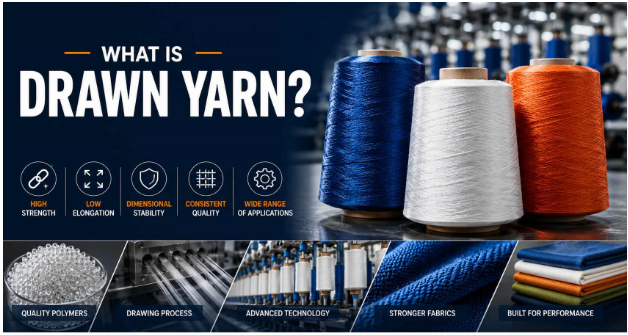
Drawn yarn is a synthetic filament yarn that has undergone a drawing process to align its polymer molecules along the fibre axis, giving it high tensile strength, low elongation, and dimensional stability. Fully Drawn Yarn (FDY) completes this orientation in a single continuous spin-draw process and is ready for weaving or knitting without further treatment, while Partially Oriented Yarn (POY) is only partly drawn and requires additional processing, typically draw-texturing into Draw Textured Yarn (DTY), before it can be used in fabric production. Selecting the right drawn yarn variant depends on the fabric’s required strength, stretch, surface finish, and end-use application.
What Is Drawn Yarn?
As manufacturers seek filament yarns that combine consistent strength, predictable shrinkage, and dimensional reliability across large production runs, drawn yarn has become a foundational input across weaving, knitting, and industrial textile manufacturing.
Drawn yarn refers to a synthetic filament yarn, most commonly polyester or nylon, that has been mechanically stretched, or “drawn,” after extrusion. This drawing step pulls the polymer chains within each filament into closer alignment along the length of the fibre. That molecular reorientation is what converts a soft, unstable as-spun filament into a yarn with higher tenacity, lower elongation, and stable dimensions suitable for downstream textile processing.
The term “drawn yarn” is most often used interchangeably with Fully Drawn Yarn (FDY), the variant in which drawing is completed fully during manufacturing so the yarn requires no further orientation before use.
What Materials Are Used to Make Drawn Yarn?
Drawn yarn is manufactured almost exclusively from thermoplastic polymers that can be melted, extruded into continuous filaments, and mechanically drawn without breaking. The most common materials include:
- Polyester (PET) — the dominant raw material for drawn yarn due to its high tenacity, cost efficiency, and compatibility with high-speed spin-draw lines.
- Nylon (Polyamide, PA6 and PA66) — used where higher elasticity, abrasion resistance, and softness are required.
- Polypropylene (PP) — used selectively for lightweight, moisture-resistant industrial and technical textile applications.
Polymer chip quality, including intrinsic viscosity and moisture content, directly affects how consistently the polymer melts and draws, which is why manufacturers dry and condition chips carefully before extrusion.
How Is Drawn Yarn Manufactured?
Drawn yarn is produced through a sequence of tightly controlled steps:
- Polymer preparation. Polyester or nylon chips are dried to remove moisture that would otherwise cause degradation during melting.
- Melt extrusion. The dried polymer is melted and forced through a spinneret, a metal plate with fine holes that determine the number and cross-sectional shape of the filaments.
- Quenching. The molten filaments are cooled with controlled airflow so they solidify into continuous strands before further processing.
- Drawing. The solidified filaments pass over a series of heated godet rollers rotating at increasing speeds. This mechanical stretching orients the polymer molecules along the fibre axis, increasing tenacity and reducing elongation.
- Heat setting. The drawn filaments are heat-stabilized to lock in the oriented molecular structure and minimize residual shrinkage.
- Winding. The finished yarn is wound onto packages under controlled tension to ensure uniform package density and consistent unwinding during downstream processing.
In Fully Drawn Yarn production, spinning and drawing occur in a single continuous high-speed line, known as spin-draw-wind. In Partially Oriented Yarn production, the filaments are wound at high speed with only partial molecular orientation, leaving full drawing (or draw-texturing) to a separate downstream process.
What Are the Key Properties of Drawn Yarn?
The drawing process gives drawn yarn a distinct property profile that separates it from undrawn or partially oriented filament yarn.
High Tenacity. Molecular alignment achieved during drawing allows the yarn to withstand greater tensile stress before breaking. This reduces yarn breakage during high-speed weaving and knitting, which lowers machine stoppages and improves production efficiency.
Low and Stable Elongation. Because the polymer chains are already oriented, drawn yarn stretches significantly less under tension than undrawn yarn. This dimensional predictability helps manufacturers maintain consistent fabric width, weight, and construction across production batches.
Low Shrinkage. Heat setting after drawing stabilizes the yarn’s structure, reducing the risk of shrinkage during dyeing, finishing, or garment washing. This protects finished fabric dimensions and reduces rejection rates.
Uniform Denier and Filament Consistency. Controlled extrusion and drawing produce yarn with consistent linear density along its length, supporting even fabric appearance and predictable dyeing behaviour.
Smooth Surface and Lustre. Fully drawn yarn typically retains a smooth, continuous filament surface, giving finished fabrics a bright or semi-dull lustre depending on the polymer’s delustering additive level.
Also Read: Properties and Applications of Drawn Textured Yarn
Types of Drawn Yarn Used in the Textile Industry
Not all drawn yarn is identical. The degree of molecular orientation and any subsequent processing determine which category a yarn falls into.
Fully Drawn Yarn (FDY)
FDY completes the full draw ratio during the initial spin-draw-wind process. The result is a smooth, high-tenacity, low-elongation yarn that is ready for weaving, knitting, or sewing thread production without further drawing. Because no additional orientation step is required, FDY offers manufacturers a shorter, more efficient production route from polymer to finished yarn.
Partially Oriented Yarn (POY)
POY is spun and wound at high speed with only partial molecular orientation. It is not intended as a finished, end-use yarn. Instead, POY serves as feedstock for further processing, typically draw-texturing, where it is simultaneously drawn to full orientation and textured to introduce bulk, crimp, or stretch.
Draw Textured Yarn (DTY)
DTY is produced by feeding POY through a false-twist texturing machine, where it is drawn to full molecular orientation and mechanically textured in a single continuous process. Texturing introduces crimp and bulk into the filament structure, giving DTY greater stretch, softness, and covering power than smooth FDY. DTY is widely used where fabric comfort, elasticity, and a fuller hand feel are required.
What Is Drawn Yarn Used For?
Woven apparel fabrics. FDY’s smooth surface, strength, and dimensional stability make it well suited to structured woven fabrics such as sarees, dress materials, linings, and shirting, where a clean drape and consistent width are required.
Sewing and embroidery thread. The high tenacity and uniform denier of FDY support consistent stitch formation and reduce thread breakage during high-speed industrial sewing and embroidery.
Warp yarn in weaving. Because FDY has low elongation and stable dimensions, it performs reliably as a warp yarn, where consistent tension across thousands of ends is essential to avoid loom stoppages.
Home textiles. FDY and its blends are used in curtains, upholstery backing, and furnishing fabrics that require dimensional stability and durability.
Knitwear and apparel requiring stretch. DTY, with its inherent crimp and bulk, is widely used as an activewear yarn in knitted apparel, hosiery, sportswear, and performance wear, offering comfort, elasticity, and a soft hand feel.
Technical and industrial textiles. Depending on polymer selection and draw ratio, drawn yarn is also used in narrow fabrics, industrial webbing, and technical textile components where strength and consistency are critical.
Fully Drawn Yarn vs Draw Textured Yarn: What’s the Difference?
FDY and DTY both begin from the same polymer base but diverge in processing, which produces two structurally different yarns suited to different fabric outcomes.
| Parameter | Fully Drawn Yarn (FDY) | Draw Textured Yarn (DTY) |
| Filament structure | Smooth, straight, continuous filament | Crimped, textured filament with bulk |
| Elasticity and stretch | Low stretch, dimensionally stable | High stretch and recovery |
| Surface and hand feel | Smooth, glossy or semi-dull surface | Soft, textured, matte-leaning hand feel |
| Processing requirement | Ready to use after spin-draw-wind | Requires a separate draw-texturing process |
| Typical fabric use | Sarees, linings, shirting, sewing thread, warp yarn | Knitwear, hosiery, sportswear, stretch apparel |
| Relative cost | Generally lower due to shorter process route | Slightly higher due to the added texturing step |
Neither yarn is universally “better.” FDY is generally preferred where a fabric needs strength, a smooth finish, and dimensional stability, while DTY is generally preferred where stretch, bulk, and a softer hand feel are the priority. Many manufacturers use both yarn types across different fabric constructions within the same product range.
Also Read: The Role of Fully Drawn and High Tenacity Polyester Yarn in Textile Industry
Drawn Yarn vs POY: What’s the Difference?
Because POY and fully drawn yarn originate from similar spinning processes, buyers sometimes confuse the two. The distinction lies almost entirely in molecular orientation and end-use readiness.
| Parameter | Drawn Yarn (FDY) | POY (Partially Oriented Yarn) |
| Molecular orientation | Fully oriented during manufacturing | Only partially oriented |
| End-use readiness | Ready for weaving, knitting, or sewing | Requires further drawing or draw-texturing |
| Tenacity | High and stable | Lower, with less predictable performance |
| Elongation | Low and stable | High, and not yet stabilized |
| Role in the supply chain | Finished, end-use yarn | Intermediate feedstock for FDY or DTY production |
In practical terms, POY is not a substitute for drawn yarn; it is an upstream input that must pass through additional processing before it can perform as a finished textile yarn.
Is Drawn Yarn Suitable for Apparel Manufacturing?
Drawn yarn is widely used across apparel manufacturing, but suitability depends on which variant is selected relative to the fabric’s performance requirements.
FDY is well suited to apparel categories where a smooth surface, defined drape, and dimensional stability matter more than stretch, such as sarees, formal shirting, dress materials, and structured linings. Its low elongation also makes it easier to maintain consistent garment dimensions through cutting, sewing, and finishing.
DTY, as a drawn and textured yarn, is better suited to apparel that depends on comfort, recovery, and a softer hand feel, including knitwear, activewear, hosiery, and stretch-woven fabrics.
Manufacturers frequently combine both yarn types, or blend drawn yarn with natural fibres, to balance strength, drape, and comfort within a single garment category.
Advantages of Drawn Yarn
High tensile strength reduces yarn breakage during high-speed weaving and knitting, supporting fewer machine stoppages and more consistent production output.
Dimensional stability helps manufacturers maintain predictable fabric width, weight, and shrinkage behaviour across large production runs.
Batch-to-batch consistency in denier and filament count supports uniform dyeing, even fabric appearance, and predictable downstream processing.
Processing efficiency, particularly for FDY, comes from eliminating a separate drawing step, shortening the production route from polymer to finished yarn.
Application versatility allows drawn yarn, across its FDY and DTY forms, to serve apparel, home textile, industrial, and technical textile applications from a shared manufacturing base.
Also Read: Advantages of Fully Drawn and High Tenacity Yarns in Technical Textiles
Limitations and Considerations of Drawn Yarn
Limited inherent stretch in FDY. As a smooth, fully oriented filament yarn, FDY does not offer the elasticity of textured yarns, making it less suitable, on its own, for garments requiring significant stretch and recovery.
Process sensitivity. Draw ratio, temperature, and tension must be tightly controlled during manufacturing; inconsistent drawing conditions can produce variable tenacity and elongation, affecting downstream performance.
Moisture and comfort characteristics. Smooth filament structures such as FDY offer less inherent bulk and air entrapment than textured yarns, which can influence comfort in apparel where breathability and softness are priorities.
Selection complexity. With FDY, POY, and DTY all originating from similar processes but serving different roles, buyers unfamiliar with filament yarn manufacturing can select the wrong variant for their intended fabric outcome without proper technical guidance.
How to Choose the Right Drawn Yarn?
Selecting the appropriate drawn yarn variant should be based on measurable specifications rather than price alone.
Denier and filament count determine yarn thickness and fabric weight, and should match the target fabric construction.
Tenacity and elongation should be evaluated against the mechanical stresses expected during weaving, knitting, or garment use.
Shrinkage behaviour should be verified, particularly for fabrics that will undergo dyeing, heat setting, or repeated washing.
Lustre level, bright, semi-dull, or dull, should be matched to the finished fabric’s intended visual appearance.
Fabric end-use should guide the choice between FDY, for structured, smooth-finish fabrics, and DTY, for stretch, bulk, or a softer hand feel.
Supplier consistency and testing capability should be verified, since batch-to-batch variation in tenacity, denier, or shrinkage can create downstream production and quality issues.
Machine compatibility should also be confirmed, since yarn package density, winding tension, and filament uniformity affect how smoothly the yarn runs on weaving, knitting, or texturing equipment.
Conclusion
Drawn yarn plays a foundational role in synthetic textile manufacturing, converting as-spun polymer filament into a yarn with the tenacity, dimensional stability, and consistency required for reliable downstream processing. Understanding how Fully Drawn Yarn, Partially Oriented Yarn, and Draw Textured Yarn differ in molecular orientation and end-use readiness allows manufacturers and procurement teams to select the correct yarn variant for a given fabric outcome, whether that priority is strength and drape or stretch and softness. Evaluating specifications such as denier, tenacity, elongation, shrinkage, and supplier consistency remains the most reliable path to informed sourcing decisions.
Key Takeaway
- Drawn yarn is a synthetic filament yarn whose polymer molecules have been mechanically oriented through a drawing process, giving it high tenacity, low elongation, and dimensional stability.
- Fully Drawn Yarn (FDY) completes drawing in a single spin-draw-wind process and is ready for weaving or knitting without further treatment.
- Partially Oriented Yarn (POY) is only partly oriented and serves as feedstock for further drawing or draw-texturing, not as a finished yarn.
- Draw Textured Yarn (DTY) is produced by drawing and texturing POY simultaneously, adding crimp, bulk, and stretch that FDY does not have.
- FDY generally suits structured, smooth-finish fabrics such as sarees, shirting, linings, and sewing thread, while DTY generally suits stretch and comfort-driven apparel such as knitwear, hosiery, and sportswear.
- Choosing the right drawn yarn variant depends on denier, tenacity, elongation, shrinkage, lustre, fabric end-use, and supplier consistency, not on price alone.