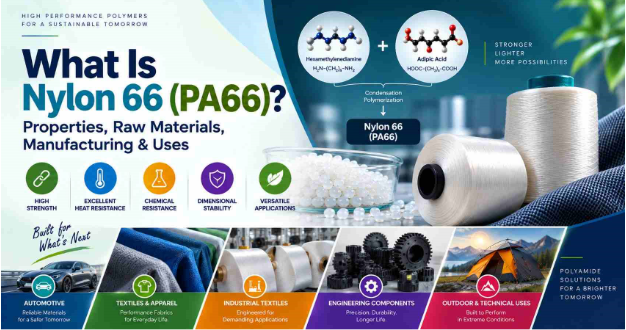
Nylon 66, also written as nylon 6.6, nylon 6 6, PA6 6, or polyamide 66, is a synthetic polyamide produced from two raw materials, hexamethylenediamine and adipic acid, rather than the single monomer used to make nylon 6. Nylon 66 material is recognized for its high mechanical strength, high melting point, good chemical resistance, and strong dimensional stability under heat, which is why nylon 66 products are widely used across automotive, industrial, and high-performance textile applications. Understanding nylon 66’s raw material, how it is made, and its mechanical, thermal, and chemical properties helps manufacturers and procurement teams evaluate whether it is the right polyamide for a given application.
What Is Nylon 66?
As manufacturers across automotive, industrial, and technical textile sectors look for fibres that hold their strength and shape under heat and mechanical stress, nylon 66 has remained one of the most established engineering polyamides for both textile and industrial use.
Nylon 66 is a synthetic polymer within the polyamide family, commonly written as PA66, PA 6.6, polyamide 6 6, or polyamide 6.6. It is classified as a polyamide because its polymer chain is built from repeating amide linkages, the same chemical feature that defines all nylon types. What distinguishes nylon 66 from nylon 6 is its raw material and production route: nylon 66 is a condensation polymer made from two different monomers, while nylon 6 is made from a single monomer, caprolactam.
Nylon 6.6, nylon 6 6, nylon 6 6 6, PA6 6, nylon PA 6.6, nylon PA 66, and polyamide PA 66 are all alternate ways the same polymer is written across technical documentation, product catalogues, and search queries, and all refer to the identical material.
What Is Nylon 66 Made From? (Raw Material)
The raw material for nylon 66 consists of two petrochemical-derived monomers: hexamethylenediamine and adipic acid. Nylon 66 is made by reacting these two monomers together in a condensation polymerization process, which releases water as a by product and forms long polymer chains linked by amide bonds. This two-monomer route is the defining reason nylon 66 carries its “66” designation, referring to the six-carbon structure present in each of its two raw materials.
Once polymerized, nylon 66 is typically supplied as chips or granules to downstream manufacturers, who dry and melt the polymer before extruding it into filament yarn or moulding it into engineering components. Because both raw materials for nylon 66 are produced under controlled industrial conditions, manufacturers can maintain consistent polymer molecular weight and viscosity across production batches, supporting predictable spinning and moulding performance.
As with other polyamides, nylon 66 raw material can also be sourced from recycling routes, where suitable nylon 66 waste streams are reprocessed for reuse in new fibre or resin production.
Also Read: Nylon Manufacturing Process and Its Uses
How Is Nylon 66 Manufactured Into Fibre?
Converting nylon 66 polymer into usable textile fibre follows a consistent sequence:
- Condensation polymerization. Hexamethylenediamine and adipic acid are reacted together to form nylon 66 salt, which is then polymerized into nylon 66 resin.
- Drying. The resulting polymer chips are dried thoroughly, since residual moisture can degrade the polymer during melting and reduce fibre quality.
- Melt extrusion. The dried polymer is melted and forced through a spinneret, a plate with fine holes that determines filament count and cross-sectional shape.
- Quenching. The molten filaments are cooled with controlled airflow so they solidify into continuous strands.
- Drawing. The filaments are stretched over heated rollers, aligning the polymer molecules along the fibre axis to increase tenacity and reduce elongation.
- Heat setting and winding. The drawn filaments are heat-stabilized and wound onto packages under controlled tension for downstream weaving, knitting, or further processing.
This process can be adjusted to produce fully drawn yarn, textured yarn, or staple fibre from nylon 66, depending on whether the end application calls for a smooth filament structure, added bulk and stretch, or a spun-yarn construction.
What Are the Properties of Nylon 66?
Mechanical Properties of Nylon 66
Nylon 66 offers high tensile strength and good stiffness relative to many other polyamide fibres, which allows it to withstand demanding mechanical stress during both processing and end use. Its molecular structure, built from long, closely packed polymer chains, gives nylon 66 strong resistance to deformation under load, supporting reliable performance in applications where the fibre or component is repeatedly stressed, flexed, or abraded.
Thermal Properties of Nylon 66
Nylon 66 has a notably higher melting point than nylon 6, which allows it to maintain dimensional stability and mechanical performance across a wider temperature range. This thermal resistance is a key reason nylon 66 is preferred in automotive and industrial applications where the material may be exposed to sustained heat during processing or in service, such as engine-compartment components or heat-set textile constructions.
Chemical Properties and Chemical Resistance of Nylon 66
The chemical properties of nylon 66 include good resistance to a range of oils, greases, fuels, and many common industrial chemicals, which supports its use in automotive and industrial environments where exposure to such substances is routine. Like other polyamides, nylon 66’s amide linkages remain sensitive to strong acids and certain oxidizing agents, so chemical compatibility should always be verified against the specific exposure conditions of an application.
UV Resistance of Nylon 66
Nylon 66’s inherent resistance to ultraviolet degradation is moderate; prolonged, unprotected UV exposure can gradually reduce tensile strength and affect colour over time. For outdoor or long-term exposure applications, manufacturers commonly use UV-stabilizing additives or protective finishes to extend the material’s service life in sunlight-exposed conditions.
Additional Properties
Nylon 66 also offers good elasticity and recovery, strong abrasion resistance, and lower moisture absorption than nylon 6, which contributes to more consistent dimensional stability in humid conditions. Its smooth filament surface supports a bright lustre and efficient dye uptake, though its higher crystallinity generally requires more energy-intensive dyeing conditions than nylon 6.
Also Read: Benefits of Industrial Nylon & Woven Fabrics
Key Differences Between Nylon 66 vs Nylon 6
Nylon 66 and Nylon 6 are both widely used polyamides, but differences in their polymer structure and production routes result in different thermal, mechanical, moisture, and processing characteristics. The appropriate material depends on the technical requirements of the application.
| Comparison Factor | Nylon 66 (PA66) | Nylon 6 (PA6) |
| Polymer type | Polyamide 66 | Polyamide 6 |
| Raw materials | Hexamethylenediamine and adipic acid | Caprolactam |
| Polymerization route | Condensation polymerization | Ring-opening polymerization |
| Melting point | Higher than Nylon 6 | Lower than Nylon 66 |
| Heat resistance | Generally higher | Generally lower than Nylon 66 |
| Mechanical performance | High strength, stiffness, and dimensional stability | Good strength, elasticity, abrasion resistance, and flexibility |
| Moisture absorption | Generally lower than Nylon 6 | Generally higher than Nylon 66 |
| Dye affinity | Generally lower than Nylon 6 | Generally higher |
| Processing temperature | Generally requires higher processing temperatures | Generally requires lower processing temperatures |
| Flexibility and hand feel | Generally firmer and stiffer | Generally softer and more flexible |
| Chemical resistance | Good resistance to oils, fuels, and many common industrial chemicals; compatibility depends on exposure conditions | Good chemical resistance, with performance depending on the chemical, concentration, temperature, and exposure conditions |
| UV resistance | Moderate inherent resistance; stabilization may be required for prolonged outdoor exposure | Can also be affected by prolonged UV exposure; stabilization may be required for outdoor applications |
| Typical textile applications | Automotive textiles, technical textiles, industrial fabrics, carpet yarns, and performance apparel | Apparel, hosiery, carpet yarns, linings, and industrial textiles |
| Engineering applications | Engineering components requiring higher heat resistance, stiffness, and dimensional stability | Engineering components, films, and moulded parts where its balanced mechanical and processing characteristics are suitable |
| Key selection considerations | Heat exposure, stiffness, dimensional stability, mechanical stress, and chemical environment | Dyeability, flexibility, softness, processing conditions, and balanced mechanical performance |
How to Choose Between Nylon 66 and Nylon 6?
The choice between Nylon 66 and Nylon 6 should be based on the application’s mechanical, thermal, moisture, chemical, processing, and environmental requirements. Nylon 66 may be considered where higher heat resistance, stiffness, and dimensional stability are important, while Nylon 6 may be considered where dye affinity, flexibility, softness, and processing characteristics are important. The final selection should be based on the specific grade, product specification, processing conditions, and end-use requirements.
What Is Nylon 66 Used For?
Automotive Textiles and Components. Nylon 66’s heat resistance and mechanical strength make it a preferred material for automotive interior fabrics, airbags, seat belts, and various under-hood engineering components.
Industrial and Technical Textiles. Nylon 66 products are widely used in industrial webbing, ropes, and technical fabrics where strength retention under mechanical and thermal stress is essential.
Carpet and Flooring Yarns. Nylon 66’s resilience and abrasion resistance support its use in BCF carpet yarns, particularly in commercial environments with heavy foot traffic.
Engineering Components. Beyond textile yarn fibre, nylon 66 resin is widely used in moulded engineering parts, gears, and mechanical components that require strength and heat resistance.
High-Performance Apparel. Nylon 66 fibre is used in performance apparel and hosiery applications where durability and shape retention under repeated stress are priorities.
Also Read: What is Polyester and Nylon Multifilament Yarn?
Why Is Nylon 66 Used in Industrial Applications?
High heat resistance allows nylon 66 to maintain mechanical performance in applications involving sustained or elevated temperatures, supporting reliable use in automotive and industrial settings.
Strong dimensional stability helps nylon 66 products hold their shape and performance characteristics across a wider range of processing and service conditions than several alternative polyamides.
Good chemical resistance supports nylon 66’s use in environments involving routine exposure to oils, fuels, and common industrial chemicals.
Consistent mechanical performance across production batches supports predictable downstream processing for manufacturers working with tight quality tolerances.
Limitations and Considerations of Nylon 66
Higher processing energy requirements. Nylon 66’s higher melting point generally requires more energy-intensive melting and dyeing conditions compared with nylon 6.
Cost considerations. The two-monomer production route and processing requirements for nylon 66 can make it a relatively higher-cost polyamide option compared with nylon 6 in certain markets.
UV sensitivity without stabilization. As with most polyamides, unprotected nylon 66 will gradually degrade under prolonged UV exposure, making stabilizing additives necessary for long-term outdoor applications.
Specification complexity. With nylon 66 available across a range of deniers, filament counts, and engineering grades, buyers unfamiliar with polyamide specifications may need technical guidance to select the correct grade for their application.
How to Choose the Right Nylon 66 for Your Application
Mechanical requirements should be assessed against the tensile strength, stiffness, and abrasion resistance needed for the intended use, whether textile or engineering.
Thermal exposure conditions should be confirmed, since nylon 66’s higher melting point is often the deciding factor when nylon 6 cannot meet an application’s heat requirements.
Chemical exposure should be reviewed against the specific oils, fuels, or chemicals the material will encounter in service.
UV and outdoor exposure should be planned for with appropriate stabilizing additives if the application involves prolonged sunlight exposure.
Supplier consistency and testing capability should be verified, since variation in polymer quality or moisture content between batches can affect downstream processing and finished product performance.
Conclusion
Nylon 66 remains a leading engineering polyamide for applications that demand strength, heat resistance, and dimensional stability beyond what nylon 6 typically offers. Understanding nylon 66’s raw material, how it is made from hexamethylenediamine and adipic acid, and its mechanical, thermal, chemical, and UV performance allows manufacturers and procurement teams to source the right nylon 66 material with confidence, whether for automotive, industrial, carpet, or high-performance textile applications.
Key Takeaway
- Nylon 66, also written as nylon 6.6, nylon 6 6, or PA6 6, is a polyamide made from two raw materials, hexamethylenediamine and adipic acid, through condensation polymerization.
- Nylon 66 is made into fibre through melt extrusion, drawing, and heat setting, the same core process used for other polyamide filament yarns.
- Nylon 66’s mechanical properties include high tensile strength and stiffness, while its thermal properties include a notably higher melting point than nylon 6.
- Nylon 66’s chemical resistance supports use around oils, fuels, and common industrial chemicals, though it remains sensitive to strong acids and requires UV stabilization for prolonged outdoor exposure.
- Nylon 66 products are widely used in automotive textiles and components, industrial and technical textiles, carpet yarns, and engineering parts.
- Choosing the right nylon 66 grade depends on mechanical requirements, thermal exposure, chemical exposure, UV conditions, and supplier consistency, not on price alone.