Polyester filament yarn underpins a large share of modern textile manufacturing, and the specific way that filament is drawn and oriented during production has a direct bearing on its strength, stability, and suitability for different fabric types. Among the range of polyester filament constructions, fully drawn yarn stands out for combining high strength with production efficiency.
Understanding what fully drawn yarn is, how it differs from partially oriented yarn, and where FDY yarn performs best helps manufacturers select the right filament construction for apparel, technical textile, and industrial applications rather than defaulting to a single yarn type across every product line, including hosiery/narrow fabrics, where partially oriented yarn can also be relevant.
What is Fully Drawn Yarn (FDY)?
Fully drawn yarn, commonly abbreviated as FDY, is a continuous polyester filament yarn produced at high spinning speed with intermediate drawing integrated directly into the spinning process. This distinguishes it from partially oriented yarn (POY), which is spun at lower speed and requires a separate downstream drawing or texturising step before it can be used in fabric production. Because the drawing and orientation happen inline, FDY yarn can be used directly for weaving or knitting without additional processing, simplifying the production chain for manufacturers who need a stable, ready-to-use filament yarn.
FDY Yarn vs. POY Yarn: Key Differences
| Attribute | Fully Drawn Yarn (FDY) | Partially Oriented Yarn (POY) |
| Molecular Orientation | Fully oriented and drawn during spinning. | Only partially oriented; requires further drawing. |
| Further Processing Needed | Ready for direct weaving or knitting. | Requires downstream drawing, texturising, or twisting. |
| Tensile Strength | High, due to complete molecular alignment. | Lower until further drawn. |
| Typical Use | Direct fabric production, technical textiles. | Feedstock for draw-texturising into DTY or draw-twisting. |
This comparison shows why FDY and POY are not interchangeable: POY functions primarily as an intermediate yarn for further processing, while FDY yarn is engineered for immediate use, making it the preferred choice where production efficiency and consistent filament strength are priorities.
Also Read: Differences Between Partially Oriented Yarn (POY) vs Fully Drawn Yarn (FDY)
Key Properties of Fully Drawn Yarn
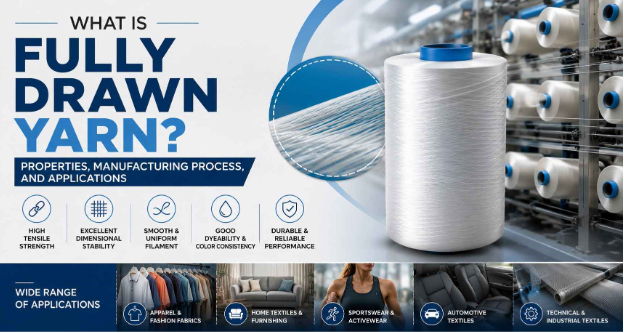
High Tensile Strength
The intermediate drawing stage aligns the polymer’s molecular chains along the length of the filament, which significantly increases tensile strength compared to undrawn or partially oriented yarn. This higher strength allows FDY-based fabrics to withstand greater mechanical stress during both processing and end use.
Excellent Dimensional Stability
Because FDY yarn is fully oriented before winding, it resists further shrinkage or elongation during subsequent weaving, knitting, or dyeing processes. This dimensional stability helps manufacturers maintain consistent fabric dimensions and reduces defects related to yarn shrinkage across production batches.
Smooth and Uniform Filament Structure
FDY yarn has a smooth, continuous filament surface with consistent diameter along its length, supporting even dye uptake and a clean fabric appearance. This uniformity also reduces friction-related processing issues on high-speed weaving and knitting equipment.
Good Dyeability and Colour Consistency
The consistent molecular structure and smooth surface of FDY yarn support even dye penetration, helping manufacturers achieve consistent colour results across production batches, which is particularly important for large export orders requiring tight colour matching, especially in home textiles applications.
How Fully Drawn Yarn is Manufactured
Polymer Melting and Extrusion
Polyester polymer chips are melted and extruded through a spinneret, a metal plate with fine holes that shapes the molten polymer into continuous filament strands as it emerges.
Filament Spinning Process
The extruded filaments are rapidly cooled and solidified, then wound at high speed. Unlike POY production, FDY spinning speeds are calibrated so that drawing can be integrated into the same continuous process rather than requiring a separate stage.
Drawing and Orientation Stages
The solidified filaments pass through heated rollers operating at different speeds, stretching the filament and aligning the polymer chains along its length. This orientation step is what gives FDY yarn its high tensile strength and low elongation compared to undrawn yarn.
Heat Setting and Winding
The drawn filament is heat-set to lock in its molecular orientation and dimensional stability before being wound onto packages for shipment. This heat-setting stage is critical to ensuring the yarn resists shrinkage during later dyeing or finishing processes.
Applications of Fully Drawn Yarn Across Industries
Apparel and Fashion Fabrics
FDY yarn’s smooth filament structure and consistent dyeability make it well suited to fashion fabrics requiring a clean surface finish and reliable colour uptake.
Home Textiles and Furnishings
Curtains, upholstery, and furnishing fabrics benefit from FDY’s dimensional stability, which helps finished textiles resist shrinkage and maintain their appearance over repeated use and cleaning.
Sportswear and Performance Textiles
The high tensile strength of FDY yarn supports the durability requirements of sportswear and performance fabrics, which are subject to repeated stretching and mechanical stress during use.
Automotive Textile Components
Automotive interior fabrics and technical components rely on FDY yarn’s strength and dimensional stability to maintain performance under sustained mechanical and thermal stress inside a vehicle.
Also Read: Advantages of Using Fully Drawn Yarn & High Tenacity Yarn in Technical Textiles
How to Choose the Right FDY Yarn
- Confirm the denier and filament count appropriate for the target fabric weight and hand feel.
- Check lustre options (bright, semi-dull, or dull) required for the finished fabric’s visual appearance.
- Verify whether the application calls for standard FDY or a recycled-polyester-based FDY construction to meet sustainability sourcing requirements.
- Confirm dyeability and colourfastness data if the yarn will go through package or fabric dyeing.
- Verify compatibility with your weaving or knitting equipment and required processing speed.
- Confirm minimum order quantities and lead times, particularly for custom denier or filament specifications.
Evaluating A Fully Drawn Yarn Manufacturer
Beyond matching specifications, buyers should confirm a manufacturer’s ability to hold consistent denier and tenacity tolerances across production batches, provide documented testing rather than visual inspection alone, and support the specific denier and filament range required for the target application.
Conclusion
Fully drawn yarn plays a foundational role in polyester textile manufacturing, offering high tensile strength, dimensional stability, and production efficiency by combining spinning and drawing into a single continuous process. From apparel and home textiles to sportswear and automotive components, FDY yarn’s properties make it suitable for applications where consistent strength and stability matter.
Selecting the right FDY yarn specification, and understanding how it differs from POY and other filament constructions, remains essential for manufacturers building fabrics that perform reliably from production through end use.
Explore AYM Syntex’s fully drawn yarn range, available across a wide denier and filament range in multiple lustres, including recycled polyester options, to find the right specification for your production line.
Key Takeaways
- FDY yarn combines spinning and drawing into a single process, unlike POY, which requires a separate downstream drawing or texturising step.
- Key properties include high tensile strength, excellent dimensional stability, a smooth uniform filament structure, and good dyeability.
- FDY yarn is produced across a wide denier and filament range, allowing it to be matched to fabric weight and end-use requirements.
- FDY can also be produced from recycled polyester, supporting sustainability-driven sourcing requirements.