Stretch performance has become a standard expectation across apparel and technical textiles, from activewear to compression wear. Meeting this expectation reliably at production scale depends heavily on the elastic yarn incorporated into the fabric, rather than on fabric construction alone.
Spandex yarns, widely known by brand names such as Lycra and Creora, are the primary material manufacturers use to introduce elasticity into fabric. Rarely used alone, spandex yarns are typically combined with polyester or nylon through core-spinning or covering constructions, including covered spandex yarn and core spun spandex yarn, to deliver stretch and recovery without compromising the base fabric’s look, feel, or durability.
What are Spandex Yarns?
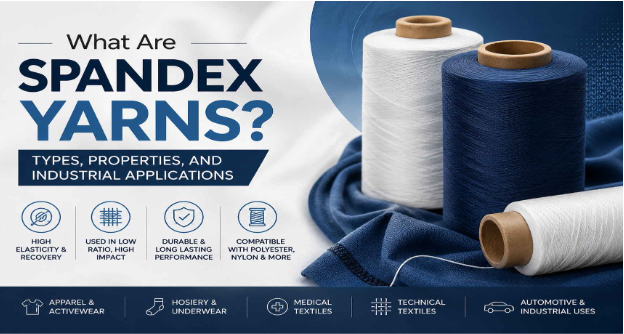
Spandex yarns are elastic yarns made from polyurethane-based fibre, engineered to stretch significantly beyond their original length and recover to close to their original shape once tension is released, a behaviour driven by the way the polymer’s molecular structure uncoils under tension and re-coils once released.
Because spandex filament alone has a rubber-like handle unsuited to most fabrics, it is rarely used in isolation. Instead, spandex is typically incorporated into yarn with spandex constructions, where it is combined with polyester or nylon through core-spinning, covering, or interweaving. This allows manufacturers to add stretch to a fabric while retaining the surface characteristics, dye behaviour, and hand feel of the primary fibre, rather than exposing the fabric surface directly to spandex filament. comfeel dyed yarn can also be considered in applications where dyed yarn characteristics are required alongside the desired fabric performance.
Types of Spandex Yarns Used in Textile Manufacturing
| Type | Construction | Common Applications |
| Bare / Raw Spandex | 100% spandex filament, typically 22-78 Dtex, rarely used directly on fabric. | Co-produced with other filaments on knitting machines for swimwear, sportswear, and stockings. |
| Core-Spun Spandex Yarn | Spandex filament forms the core, with a synthetic staple or filament sheath, commonly polyester, spun or wrapped around it during spinning. | Stretch fabrics for apparel and technical textiles where a core spun spandex yarn adds elasticity while preserving the sheath fibre’s surface characteristics. |
| Covered Spandex Yarn (SCY) | Spandex core helically wrapped by one or two layers of nylon or polyester filament using a hollow spindle. | Hosiery, socks, and weft-knitted underwear requiring high elasticity and strength. |
| Air-Covered Yarn (ACY) | Spandex entangled with another filament, such as nylon, using air jets instead of mechanical wrapping. | Warp knitting and weaving applications where a softer handle and simplified sizing are preferred. |
Selecting between these constructions depends largely on the target fabric type and processing route, since core spun and covered yarns behave differently on knitting versus weaving equipment. High-speed circular knitting typically favours covered or air-covered constructions for their smoother feed, while core spun spandex yarn suits ring and rotor spinning routes for woven stretch fabrics.
Also Read: What is Polyester Spun Yarn? Benefits and Textile Industry Uses
Key Properties of Spandex Yarns
| Property | Description |
| Elasticity and Recovery | Spandex can typically stretch several times its original length and recover close to its starting dimension, allowing finished garments to maintain fit and shape retention through repeated wear and washing, reducing returns related to sagging or loss of shape. |
| Low Usage Ratio, High Impact | Spandex is generally used at only 1-10% of total yarn content, yet this small proportion is enough to transform a rigid fabric into a stretch fabric, keeping material costs manageable relative to the performance gained. |
| Fine Denier Range | Spandex filament is available across a wide denier range, commonly 20D to 140D, allowing manufacturers to fine-tune stretch intensity from light-compression apparel to heavy-duty elastic webbing. |
| Blending Compatibility | Spandex integrates readily with polyester and nylon through core-spinning or covering, letting manufacturers retain the sheath fibre’s strength or hand feel while extending a proven base yarn into a stretch product line. |
| Durability Under Repeated Stretch | Covering or core-spinning protects the spandex filament from direct abrasion and UV exposure, helping the yarn resist fatigue and maintain consistent recovery performance across the garment’s usable life. |
These properties explain why yarn with spandex is now the default choice for stretch fabrics: a small, carefully engineered amount of spandex delivers a disproportionately large improvement in fit, comfort, and garment longevity.
Industrial Applications of Spandex Yarns
- Apparel and Activewear: Sportswear, swimwear, and leggings face continuous stretching during movement; covered or core spun spandex yarns deliver the four-way stretch and shape retention needed to maintain fit.
- Technical and Industrial Elastic Textiles: Elastic webbing, straps, and industrial stretch fabrics require high tensile durability under sustained load, met by covered spandex yarn built on polyester or nylon sheath fibres.
- Hosiery and Intimate Apparel: Stockings, socks, and underwear demand consistent recovery and a smooth surface against the skin, provided by fine-denier covered and bare spandex yarns.
- Medical and Compression Textiles: Compression garments, bandages, and support wear depend on controlled, consistent elasticity to deliver the correct pressure gradient, making higher-denier spandex constructions essential to performance. performance dyed yarn can further support applications where consistent colour and yarn performance are important.
Across these segments, the choice of spandex construction and denier is driven by the specific balance of stretch, recovery, and surface feel required for the end product.
Also Read: A Complete Guide to Polyester & Nylon Multifilament Yarn
How to Choose the Right Yarn with Spandex
- Confirm the spandex denier and ratio appropriate for the target stretch level, since a higher spandex percentage increases elasticity but can affect fabric weight and cost.
- Decide between core spun and covered spandex yarn constructions based on the intended process: core spun yarns suit ring and rotor spinning routes, while covered yarns are typically preferred for hosiery and fine knitwear, particularly when hosiery yarn is required for specialized textile applications..
- Request stretch and recovery test data, since consistent recovery performance after repeated stretching is a stronger quality indicator than stretch percentage alone.
- Verify compatibility with your knitting or weaving equipment, as spandex-containing yarns often require adjusted tension settings compared to standard yarns.
- Check colourfastness and dye compatibility of the sheath fibre used in the covered or core spun construction, since dye uptake can vary between polyester and nylon sheaths.
- Confirm minimum order quantities, lead times, and technical support, since spandex yarn sourcing often involves closer collaboration with the supplier than standard yarn purchases.
Evaluating a Spandex Yarn Manufacturer
Specification matching is only part of the sourcing decision; the supplier’s own capabilities matter just as much. Buyers should check whether a manufacturer can maintain consistent denier and recovery performance across batches, provide documented testing rather than visual inspection alone, and offer technical support along with realistic lead times for ongoing or export-oriented production.
Future Trends in Spandex Yarn Manufacturing
Demand for stretch fabrics continues to grow across both fashion and technical textile segments, pushing spandex yarn manufacturing toward more sustainable and higher-performance solutions. Recycled and bio-based spandex alternatives are gaining early traction as brands respond to sustainability expectations, while finer-denier, higher-recovery spandex developments are enabling lighter-weight stretch fabrics without sacrificing shape retention. Moisture-wicking and antimicrobial finishes are also increasingly combined with spandex-blended yarns to meet growing demand from activewear yarn and performance apparel markets.
Conclusion
Spandex yarns remain the foundation of stretch performance across modern textile manufacturing, from covered spandex yarn in activewear and elastic webbing to fine core spun constructions in hosiery and compression wear. The range of available constructions allows manufacturers to match the right spandex type and denier to the specific stretch, recovery, and surface requirements of the finished product.
Choosing the right yarn with spandex, verifying its stretch recovery and processing compatibility, and partnering with a manufacturer capable of consistent quality remain essential for delivering fabrics that perform reliably through repeated wear and washing.
Explore AYM Syntex’s range of engineered yarn solutions to discuss spandex-compatible core spun and covered yarn options for your production requirements.
Key Takeaways
- Spandex yarn is rarely used in isolation; it is typically core spun or covered with a polyester or nylon sheath.
- Four primary constructions exist: bare/raw, core spun, covered (SCY), and air-covered (ACY) spandex yarn.
- Spandex usually makes up only 1-10% of total yarn content, yet transforms a rigid fabric into a stretch fabric.
- Buyers should verify stretch recovery data, machine compatibility, and supplier consistency before sourcing.