aymsyntex

Role of Fashion Threads in Apparel Design, Durability, and Stitch Performance

What Are Fashion Threads? Fashion threads are sewing threads specifically selected for apparel manufacturing based on appearance, seam performance, fabric compatibility, and durability requirements. Unlike generic sewing threads, fashion threads are engineered to support both garment construction and visual design. In apparel manufacturing, thread selection directly affects stitch quality, seam strength, fabric handling, and the…

Read More

Choosing the Right Type of Textured Yarn for Apparel and Industrial Use

What is Textured Yarn? Textured yarn is a filament yarn that has been mechanically or thermally modified to create bulk, crimp, loops, or elasticity within the filament structure. Unlike flat filament yarns, textured yarns are engineered to improve softness, stretch, coverage, and fabric performance without cutting the continuous filaments. In textile manufacturing, texturing changes how…

Read More

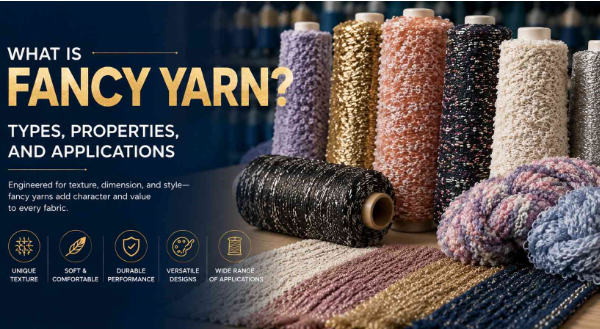
Role of Fancy Yarns in Value-Added Textile Products and Design Innovation

What Are Fancy Yarns? Structure, Types, and Manufacturing Techniques Fancy yarns are specialised yarns engineered to create decorative surface effects, irregular textures, or enhanced visual appeal in textile products. While conventional yarns focus mainly on uniformity and structural consistency, fancy yarns are intentionally designed with variations in thickness, loops, slubs, knots, curls, or colour effects….

Read More

Role of Multi-Colour Yarns in Value-Added Textile Products and Export Markets

What Are Multi-Colour Yarns? Structure and Manufacturing Techniques Multi-coloured yarns are yarns that contain two or more colours distributed along the yarn structure in a controlled manner. Compared with solid dyed yarns, which maintain a single uniform shade, multi-coloured yarns create visual variation directly at the yarn stage. These yarns are produced using specialised dyeing,…

Read More

Why Open End Yarn is Preferred in High-Volume Textile Manufacturing

What is Open End Yarn? Process and Structural Overview Open end yarn is a type of spun yarn manufactured using rotor spinning technology instead of traditional ring spinning. In this process, fibres are separated into individual strands and collected inside a rotor where yarn formation takes place continuously. Unlike conventional spinning systems that require multiple…

Read More
Cabled Yarns

Cabled Yarns: Enhancing Strength, Durability, and Performance in Industrial Textiles

Cabled yarns are widely used in textile and industrial manufacturing where higher strength, durability, and structural stability are required. By combining multiple plied yarns into a single, balanced structure, cabled yarns provide improved mechanical performance compared to standard yarn constructions. This makes them suitable for demanding applications such as ropes, carpets, industrial fabrics, and technical…

Read More
Best Yarn for Carpets

Best Yarn for Carpets: Performance, Cost, and Industrial Considerations

What Are Carpet Yarns? Carpet yarns are specialized yarns engineered for floor-covering applications such as carpets, rugs, and mats. Unlike apparel yarns, they are designed to withstand continuous foot traffic, mechanical stress, and environmental exposure while maintaining appearance and structure. Most modern carpet yarns are synthetic and produced in continuous filament form, particularly Bulked Continuous…

Read More
Polypropylene Yarns in Industrial Textiles

Polypropylene Yarns in Industrial Textiles: Strength, Durability, and Applications

What are Polypropylene Yarns? Polypropylene yarns are synthetic yarns manufactured from polypropylene polymers, designed to deliver high performance in demanding industrial environments. These yarns are produced through extrusion processes, where molten polymer is converted into continuous filaments or bulked yarn structures. Known for their low density, high durability, and resistance to chemicals and moisture, polypropylene…

Read More