Modern textile manufacturing relies on precisely engineered filament structures to balance strength, flexibility, and hand feel across widely different applications, from soft apparel fabrics to demanding industrial sewing threads. The way individual filaments are combined within a yarn has a direct bearing on how that yarn performs once converted into fabric.
Multifilament yarns, built from multiple fine continuous filaments rather than a single strand, are central to this balance. Understanding the different types of multifilament yarn, including polyester multifilament yarn, PP multifilament yarn, and nylon multifilament yarn, helps manufacturers select the right construction for apparel, home textile, and industrial applications.
What are Multifilament Yarns?
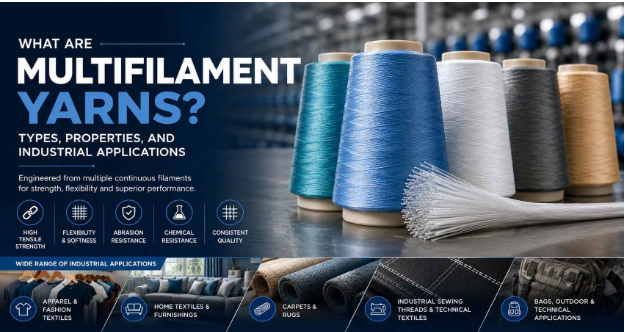
Multifilament yarns are yarns composed of many fine, continuous filaments twisted or grouped together into a single yarn structure, as opposed to monofilament yarn, which consists of a single thicker strand. Because the load in a multifilament yarn is distributed across many individual filaments rather than one, multifilament construction generally delivers greater flexibility, softness, and drape while still achieving high overall tensile strength. This combination of properties makes multifilament yarns suitable for a wide range of applications, from soft yarn for comfortable apparel fabrics to industrial sewing threads and technical textiles.
India has a well-established multifilament and BCF (Bulk Continuous Filament) yarn manufacturing base, with multi-polymer producers supplying polyester, nylon, and polypropylene multifilament yarns across domestic and export markets for apparel, home textile, and industrial applications.
Types of Multifilament Yarns Used in Textile Manufacturing
Polyester Multifilament Yarn
Polyester multifilament yarn is the most widely used multifilament construction in industrial textile manufacturing, valued for its high tensile strength, low shrinkage, and resistance to chemicals and abrasion. It is produced across a wide denier and filament range, allowing it to be matched to fabric weight requirements spanning apparel through industrial sewing thread.
Also Read: A Complete Guide to Polyester & Nylon Multifilament Yarn
Polypropylene Multifilament Yarn
PP multifilament yarn is lightweight, moisture-resistant, and chemically inert, making it well suited to applications where the fabric may face repeated wetting or chemical exposure. Polypropylene BCF and multifilament yarns are widely used in carpets, rugs, and technical textiles; specialty PP BCF constructions engineered for high lustre are used specifically in residential carpets and woven rugs where visual brightness is a key selection criterion.
Also Read: Polypropylene Yarns in Industrial Textiles: Strength, Durability, and Applications
Nylon Multifilament Yarn
Nylon multifilament nylon yarn offers higher elasticity and abrasion resistance than polyester, along with strong recovery after stretching. This makes it a preferred choice for hosiery, activewear, and products subject to repeated flexing or mechanical stress.
Textured Multifilament Yarns
Textured multifilament yarns are processed to introduce crimp, loops, or bulk into the filament structure, increasing volume, stretch, and surface coverage compared to flat multifilament yarn. This texturising process is commonly applied to polyester and nylon textured yarn to improve fabric bulk and hand feel for apparel and home textile applications.
Key Properties of Multifilament Yarn
High Tensile Strength
Distributing load across many fine filaments allows multifilament yarn to achieve high overall tensile strength while remaining flexible, since a break in one filament does not immediately compromise the strength of the entire yarn the way it would in a monofilament structure.
Flexibility and Softness
The multiple fine filaments in multifilament yarn bend more readily than a single thick monofilament strand, producing a softer hand feel and better fabric drape, which is essential for apparel and home textile applications where comfort and visual flow matter.
Abrasion Resistance
Multifilament yarns, particularly those made from nylon or polyester, resist surface wear well during repeated mechanical contact, supporting consistent performance through both processing and the finished product’s active use, whether in a garment seam or a load-bearing industrial textile.
Industrial Applications of Multifilament Yarns
Apparel and Fashion Textiles
Polyester and nylon multifilament yarns are widely used in apparel fabrics, offering the strength, softness, and drape required for garments ranging from everyday wear to activewear.
Home Textiles and Furnishings
Curtains, upholstery, and decorative fabrics use multifilament yarns for their combination of strength and soft hand feel, supporting both durability and comfort in finished home textile products.
Industrial Sewing Threads
Polyester and nylon multifilament yarns form the base of many industrial sewing threads, where flexibility combined with high tensile strength supports reliable stitching performance on high-speed sewing equipment.
Multifilament vs. Monofilament Yarn: Key Differences
| Attribute | Multifilament Yarn | Monofilament Yarn |
| Structure | Many fine continuous filaments combined into one yarn. | A single, thicker continuous filament. |
| Flexibility | High; bends easily, supporting soft drape. | Lower; stiffer hand feel. |
| Surface Feel | Generally softer, suited to apparel and home textiles. | Smoother and firmer, suited to technical and filtration uses. |
| Typical Applications | Apparel, home textiles, industrial sewing thread. | Fishing line, filtration mesh, certain technical fabrics. |
This distinction matters when specifying yarn for a new product: multifilament construction is generally the better fit wherever softness, drape, and fine stitch formation are priorities, while monofilament yarn suits applications needing a stiffer, more uniform single strand.
Future Trends in Multifilament Yarn Manufacturing
Demand for multifilament yarn continues to grow alongside broader textile industry shifts toward recycled and sustainable synthetic fibres, with recycled polyester multifilament yarn gaining traction across apparel and home textile supply chains. Advances in texturising and multi-polymer spinning technology are also enabling finer denier, higher-consistency multifilament constructions, supporting demand from performance apparel and technical textile markets seeking both sustainability credentials and reliable mechanical performance.
Conclusion
Multifilament yarns play a foundational role across apparel, home textile, and industrial sewing thread manufacturing, offering a balance of strength, flexibility, and softness that monofilament construction cannot match. From polyester and PP multifilament yarn to nylon and textured constructions, matching the right multifilament type to the application remains central to consistent fabric and product performance.
For manufacturers evaluating multifilament yarn manufacturers in India, verifying multi-polymer production capability, consistent denier and filament tolerances, and application-specific technical support helps ensure reliable sourcing across apparel, home textile, and industrial production lines.
Explore AYM Syntex’s multi-polymer multifilament yarn range, spanning polyester, nylon, and polypropylene constructions, to find the right specification for your production requirements.
Key Takeaways
- Multifilament yarn combines multiple fine continuous filaments, unlike monofilament yarn’s single thick strand.
- Polyester, polypropylene, and nylon are the primary fibres used in industrial multifilament yarn manufacturing.
- Key properties include high tensile strength, flexibility, softness, and abrasion resistance.
- Multifilament construction generally offers greater flexibility and fabric drape than monofilament yarn of comparable strength.