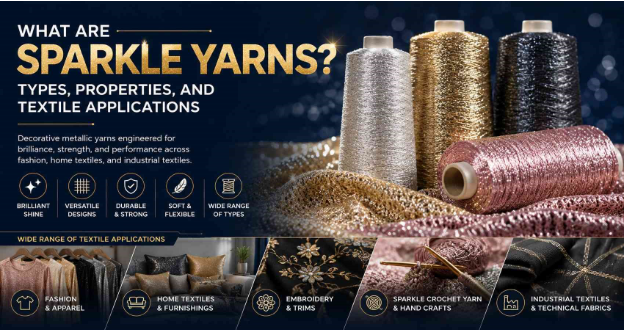
Sparkle yarns are decorative yarns made from metallised polyester film, designed to add reflective and lustrous effects to finished textiles. Available in constructions such as M-Type, MX-Type, MH-Type, and MS-Type, they offer different combinations of brilliance, strength, flexibility, and processing performance. Sparkle yarns are used across apparel, home textiles, embroidery, weaving, knitting, and craft applications such as sparkle crochet yarn. Selecting the right sparkle yarn requires evaluating its construction, denier, machine compatibility, film quality, durability, and the consistency and capabilities of the manufacturer.
Textile manufacturing continues to adapt to demand for decorative and value-added yarns that enhance the visual appeal of finished fabrics without disrupting standard weaving, knitting, or embroidery processes. Among decorative yarn categories, reflective and lustrous yarns occupy an important niche, offering manufacturers a way to add visual distinction while maintaining processing compatibility and production efficiency.
What is Sparkle Yarn?
Sparkle yarns are decorative yarns constructed using a thin metallised polyester film, engineered to reflect light and produce a shimmering or glittering effect once incorporated into fabric. Two production methods are commonly used to create this metallised effect: laminating, where a thin layer of aluminium foil is sandwiched between two layers of polyester film and slit into narrow strips, and vacuum metallization (metal deposition), where aluminium vapour is deposited directly onto a polyester film base at controlled thicknesses, typically in the range of a few hundred angstroms.
The laminated or metallised film is then slit to micro widths, ranging from roughly 1/128 inch to a few millimetres depending on the desired yarn fineness, and either used directly as a flat filament or twisted and plied with polyester, nylon, or viscose yarn for added strength. This gives manufacturers a range of options, from fine, soft filaments suited to sparkle crochet yarn and hand-knitting, to more structured constructions engineered for industrial weaving, jacquard fabric production, and machine embroidery.
Manufacturing Process of Sparkle Yarns
Producing sparkle yarn at a consistent commercial quality involves a defined sequence of processing stages, each of which directly affects the yarn’s final brightness, strength, and processing behaviour.
- Raw Material Preparation: Polyester film is selected as the base substrate, along with aluminium (for metallization) and reinforcement fibres such as viscose, nylon, or polyester yarn where a twisted or wrapped construction is required.
- Film Metallization or Lamination: Aluminium is either vapour-deposited onto the polyester film under vacuum, or laminated as a foil layer between two film layers, depending on the desired thickness, cost point, and flexibility target.
- Protective Coating: A thin resin or lacquer coating is applied over the metallised layer to protect it from oxidation, abrasion, and colour degradation during dyeing, washing, and end use.
- Precision Slitting: The coated film is slit into narrow strips at controlled micron widths, determining the fineness of the resulting flat yarn and directly influencing denier and brightness.
- Twisting and Plying: For MH, MX, and MS-type constructions, the slit film is twisted or wrapped with a reinforcement yarn to improve tensile strength, flexibility, and dimensional stability.
- Quality Inspection: Finished yarn is checked for colour consistency, film adhesion, twist uniformity, and breakage resistance before being cleared for dispatch.
- Packaging: Sparkle yarn is wound onto cones or spools sized according to end use, ranging from small put-ups for hand-craft and crochet supply chains to bulk cones for industrial weaving and knitting mills.
Each stage in this sequence has a direct bearing on the yarn’s final performance, which is why manufacturers evaluating a sparkle yarn supplier should ask about process control at each of these steps rather than judging the yarn on appearance alone.
Also Read: What is Yarn? Explore the Different Types of Yarns
Different Types of Sparkle Yarns
Sparkle yarns are manufactured in several constructions, each suited to different processing methods, fabric types, and end-use requirements.
Sparkle yarns are manufactured in several constructions, each suited to different processing methods, fabric types, and end-use requirements.
| Type | Construction | Common Applications |
| M-Type | Metallised or laminated film cut directly into flat yarn, without additional reinforcement, offering the brightest and most reflective finish. | Decorative trims and craft yarns where visual brilliance takes priority over tensile strength. |
| MX-Type | Metallic film bonded with polyester or nylon monofilament on both sides for added stability. | Continuous weaving lines and jacquard fabric production requiring dimensional stability. |
| MH-Type | Metallic flat yarn twisted with polyester, nylon, or viscose yarn, producing an irregular, textured surface. | Sweaters, scarves, and knitted fabrics, including many sparkle crochet yarn blends. |
| MS-Type | Metallic film wrapped with polyester or nylon yarn in a cylindrical structure. | Machine embroidery threads and high-speed processing where tensile strength and smooth feed are required. |
Each construction offers manufacturers a different balance of luster, strength, and flexibility, allowing sparkle yarn to be selected according to the specific fabric, garment, or craft application it is intended to support.
Types of Sparkle Yarn: M-Type, MX-Type, MH-Type and MS-Type
| Requirement | Recommended Sparkle Yarn Type |
| Maximum brilliance / shine | M-Type Sparkle Yarn |
| Machine embroidery | MS-Type Sparkle Yarn |
| Hand-knitting or weft knitting | MH-Type Sparkle Yarn |
| High-speed weaving / jacquard | MX-Type Sparkle Yarn |
| Sparkle crochet yarn / hand-craft | MH-Type, fine denier |
Also Read: What are Melange Yarns? Unveiling Their Benefits and Top Application
Key Properties of Sparkle Yarns
The performance of sparkle yarn in textile manufacturing depends on a combination of visual and mechanical properties. The most important of these properties carry consequences that extend well beyond the yarn itself, from how it behaves on processing machinery to how the finished product is perceived commercially.
| Property | Description |
| Reflectivity and Luster | Achieved through the metallised film surface and stabilised by the protective resin coating, which prevents oxidation and dulling. Consistent reflectivity translates into clear visual differentiation on the finished fabric, supporting a premium or luxury appearance that helps brands achieve stronger shelf and product differentiation. |
| Tensile Strength and Flexibility | Twisted or wrapped constructions such as MX and MS types offer improved tensile strength, while pure film-based M-type yarn prioritises brightness and requires more careful handling. Higher tensile strength reduces yarn breakage on high-speed machinery, which in turn lowers production downtime and rework costs for manufacturers running large fabric orders. |
| Colour Stability and Fade Resistance | Supported by resin or lacquer coatings applied after metallization, which protect the reflective layer from dye chemicals, moisture, and UV exposure. Reliable colour stability reduces batch rejection rates and supports consistent branding across export orders where colour matching is closely scrutinised by buyers. |
| Lightweight, Fine Structure | A direct result of the thin film and precision slitting process. This reduces overall machine load and yarn tension variation, improves yarn feed consistency during knitting or weaving, and helps maintain the natural handle of the base fabric, supporting smoother, higher-efficiency production runs. |
| Compatibility with Blending and Plying | Engineered through controlled twist levels during the twisting/plying stage, allowing sparkle yarn to combine reliably with polyester, nylon, viscose, and cotton. This flexibility lets manufacturers create custom novelty yarns for varied fabric requirements without redesigning their base yarn supply chain. |
Taken together, these properties show why sparkle yarn selection is rarely just a matter of choosing ‘the shiniest option’ — each property carries a direct manufacturing consequence and, ultimately, a commercial one.
Textile Applications of Sparkle Yarns
The versatility of sparkle yarn allows it to serve a broad range of fashion, home textile, and craft-oriented applications.
-
Apparel and Fashion Knitwear
Sparkle yarn is commonly used in sweaters, scarves, and eveningwear, where its reflective finish adds visual distinction to knitted and woven fabrics without significantly increasing fabric weight.
-
Home Textiles and Decorative Fabrics
Curtains, cushions, upholstery trims, and festive decor fabrics frequently incorporate sparkle yarn to add shimmer and visual interest while maintaining durability for regular use.
-
Sparkle Crochet Yarn and Hand-Craft Applications
Sparkle crochet yarn and sparkle yarn for crochet are widely used in hand-knitting and crochet projects, including accessories, festive items, and decorative textile crafts. Fine, flexible constructions are typically preferred here, often used as a carry-along thread alongside a base yarn to add shimmer without changing the gauge of the finished piece.
-
Embroidery, Trims, and Labels
Jacquard fabrics, garment labels, ribbons, and braids commonly use MX and MS-type sparkle yarns, which offer the tensile strength and smooth feed required for embroidery machines and high-speed weaving equipment.
These applications demonstrate the versatility of sparkle yarn across both large-scale industrial textile yarn production and smaller-batch craft and hand-knitting supply chains.
Also Read: A Complete Guide to Polyester & Nylon Multifilament Yarn
Sparkle Yarn Quality Control and Cost Factors
Consistent sparkle yarn quality depends on inspection and testing practices applied at each stage of production, along with careful handling once the yarn is finished.
- Inspection: Checking film adhesion, colour uniformity, and twist consistency across production batches.
- Testing: Verifying tensile strength, breakage resistance, and colour stability under simulated washing or light exposure conditions.
- Packaging: Winding onto appropriately sized cones or spools to prevent film distortion during transport and storage.
- Storage and Humidity Control: Maintaining stable humidity and temperature conditions during storage, since excess moisture can affect resin coatings and film adhesion over time.
- Handling: Careful unwinding and feed-tension management during downstream processing to avoid kinking or film splitting.
Cost for sparkle yarn is primarily driven by film quality and thickness, the precision of the slitting process, the type and quality of protective coating applied, the grade of polymer used in the base film, and whether the metallic effect is achieved through lamination or vacuum metal deposition, with the latter generally supporting thinner, more flexible constructions at a different cost point. Order volume and required colour customisation also influence final pricing.
Choosing a Reliable Sparkle Yarn Manufacturer
Buyers and manufacturers should evaluate both product specifications and supplier capabilities when sourcing sparkle yarn, and a genuinely consultative sourcing process goes beyond basic quality checks.
- Evaluate film thickness and slitting consistency to ensure uniform brightness and yarn diameter across production batches.
- Verify twisting and plying quality when sourcing MH or MX-type yarns intended for knitting or weaving applications.
- Confirm which denier and construction is appropriate for the intended end use, since fine deniers suited to sparkle crochet yarn differ substantially from the specifications needed for industrial weaving.
- Clarify batch-to-batch variation tolerance, particularly for colour and luster, ahead of placing export or branded production orders.
- Ask whether flat film (M-type) or wrapped/twisted (MH, MX, MS-type) construction better suits the target machinery and fabric handle.
- Confirm minimum order quantity flexibility, lead time, and technical support availability, since craft and hand-knitting supply chains often require smaller, more frequent batches than industrial weaving orders.
- Check export quality documentation and any relevant certifications where the order is intended for international markets.
Careful evaluation of these factors helps buyers secure sparkle yarn that performs reliably across both industrial textile production and hand-craft applications.
Also Read: What are Viscose Yarn and Viscose Filament Yarn? Uses and Differences
Common Buyer Mistakes When Sourcing Sparkle Yarn
- Choosing a yarn based on shine alone, without checking tensile strength or machine compatibility.
- Ignoring compatibility between the sparkle yarn construction and the intended weaving, knitting, or embroidery equipment.
- Selecting an incorrect yarn count or denier for the intended fabric weight and gauge.
- Overlooking the durability of the protective coating, which affects long-term colour and film stability.
- Failing to test washing and light-fastness performance before committing to large production runs.
- Not confirming batch-to-batch consistency, which can create visible variation across a finished order.
Technical Standards and Testing
While requirements vary by market and end use, buyers evaluating sparkle yarn typically request some combination of colourfastness testing (covering both washing and light exposure), tensile strength evaluation, and abrasion resistance testing as part of standard quality verification. Requesting this test data, particularly for export-oriented or branded production, helps confirm that a given sparkle yarn batch will perform consistently once converted into finished fabric or garments.
Also Read: Introducing Sparkle Yarn By AYM Syntex Limited
Future Trends in Sparkle Yarn Manufacturing
Demand for sparkle yarn continues to expand beyond traditional fashion and home décor segments, with growing interest from the hand-knitting and craft yarn industry, where sparkle crochet yarn and sparkle yarn for crochet have gained popularity among yarn brands and craft suppliers.
In response, manufacturers are developing softer, more flexible sparkle yarn constructions that reduce friction and breakage during hand-knitting and crochet use, while maintaining reflective quality. Early-stage development of recycled metallic yarn and lower-impact coatings is also emerging as sustainability expectations extend into decorative yarn categories, alongside wider colour customisation, improved fade resistance through advanced film coatings, and growing compatibility with digital and automated textile manufacturing processes.
Conclusion
Sparkle yarn plays a distinctive role in modern textile manufacturing, combining a reflective, decorative finish with constructions engineered for compatibility across weaving, knitting, embroidery, and hand-craft applications. From M-type film yarns valued for brightness to MX and MS-type yarns built for processing stability, the range of available constructions, deniers, and reinforcement options allows manufacturers to match sparkle yarn precisely to specific fabric, machine, and product requirements.
Whether supplying fashion knitwear, home textile décor, or sparkle crochet yarn for the hand-knitting market, selecting the right sparkle yarn type, verifying its processing and quality credentials, and partnering with a manufacturer capable of consistent batch quality remain essential for achieving reliable luster, durability, and product performance across production runs.
Key Takeaways
- Sparkle yarns are decorative yarns made using metallised polyester film to create a reflective or shimmering effect in finished textiles.
- Common sparkle yarn types include M-Type, MX-Type, MH-Type, and MS-Type, with each construction offering different levels of brilliance, strength, flexibility, and processing suitability.
- The manufacturing process involves film metallization or lamination, protective coating, precision slitting, twisting or plying, quality inspection, and packaging.
- Key sparkle yarn properties include reflectivity, tensile strength, flexibility, colour stability, lightweight construction, and compatibility with blending and plying.
- Machine compatibility and tension control are important because film-based constructions can be more sensitive to friction, heat, tension, and breakage than conventional yarns.
- Sparkle yarns are used in fashion knitwear, home textiles, embroidery, trims, jacquard fabrics, and hand-knitting and crochet applications.
- Sparkle crochet yarn and fine-denier constructions are particularly suited to hand-knitting and craft applications where flexibility and visual effect are important.
- Buyers should evaluate film quality, denier, construction, slitting consistency, protective coating, colour stability, machine compatibility, MOQ, lead time, and batch-to-batch consistency when sourcing sparkle yarn.
- Choosing a reliable sparkle yarn manufacturer is important for maintaining consistent luster, strength, processing performance, and quality across production batches.