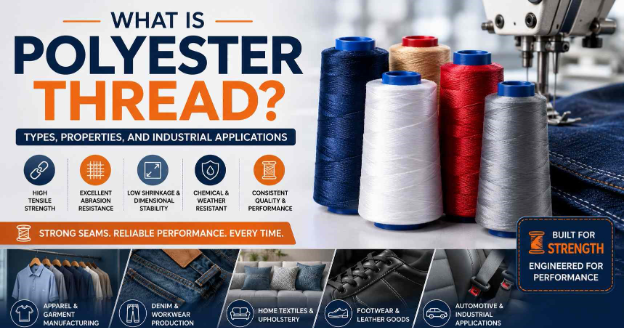
Polyester thread is a synthetic sewing thread engineered for high tensile strength, abrasion resistance, and dimensional stability. Common industrial forms include spun, filament, core-spun, and high-tenacity polyester thread, with the latter engineered specifically for demanding applications such as safety belts, automotive components, and heavy-duty industrial products.
Seam performance in industrial sewing depends heavily on thread selection, and polyester has become the dominant fibre choice across apparel, technical textiles, and heavy-duty industrial products. Its combination of strength, consistency, and resistance to environmental stress makes it the default option where seams must perform reliably at production speed and hold up over the product’s working life.
Understanding the different types of polyester thread, from everyday spun polyester sewing thread to high-tenacity variants engineered for safety-critical applications, helps manufacturers match the right poly thread to the right seam, rather than defaulting to a single construction across every product line.
What is Polyester Thread?
Polyester thread is a synthetic sewing thread manufactured from polyester polymer, most commonly PET, though PBT and PTT variants are also used in the textile industry for specific performance characteristics such as dimensional stability and stretch recovery. Polyester thread is engineered with controlled twist, consistent diameter, and a smooth surface finish, allowing it to feed reliably through industrial sewing machines at high speed without excessive breakage or fraying. Compared to natural-fibre threads, polyester offers greater resistance to shrinkage, chemical exposure, and repeated mechanical stress, which is why it has become the standard thread fibre across industrial textile manufacturing.
Types of Polyester Threads Used in Textile Manufacturing
Spun Polyester Thread
Spun polyester thread is made by twisting short polyester staple fibres together, producing a soft, slightly textured surface with good stitch coverage. It is a cost-effective, widely available option suitable for general-purpose garment manufacturing and light-to-medium weight fabrics.
Filament Polyester Thread
Filament polyester thread is made from continuous polyester filaments rather than staple fibres, giving it a smoother surface, higher strength-to-thickness ratio, and better resistance to friction during high-speed sewing. This makes it well suited to applications where surface smoothness and consistent tensile performance matter more than a soft, matte finish.
Core-Spun Polyester Sewing Thread
Core-spun polyester sewing thread combines a continuous polyester filament core with a spun polyester fibre wrapped around it. This construction delivers the tensile strength of a filament core together with the smoother, more matte surface feel of a spun thread, making it a versatile choice across general apparel and industrial sewing applications.
High-Tenacity Polyester Thread
High-tenacity polyester thread is engineered for applications where strength is the deciding factor. It is typically produced in low-shrinkage and regular-shrinkage variants: low-shrinkage constructions are commonly used in automotive components, outdoor fabrics, conveyor belts, and filter fabrics, while regular-shrinkage constructions are more common in safety belts, webbing, overlock threads, and rope or net products. Both variants are valued for high durability, toughness, and chemical resistance under demanding operating conditions.
Spun vs Filament vs Core-Spun vs High-Tenacity Polyester Thread
| Thread Type | Key Characteristic | Typical Applications |
| Spun Polyester | Soft surface and good stitch coverage | Apparel and general sewing |
| Filament Polyester | Smooth surface and high strength-to-thickness ratio | Industrial and high-speed sewing |
| Core-Spun Polyester | Filament-core strength with spun outer surface | Apparel and industrial sewing |
| High-Tenacity Polyester | High strength and durability | Automotive, safety belts, webbing and technical products |
Key Properties of Polyester Thread
High Tensile Strength
Polyester’s high tensile strength allows seams to withstand significant stress before failing, which is particularly important on high-speed industrial machines where thread is subjected to repeated tension cycles. This directly reduces seam breakage rates and the associated rework and downtime on a production line.
Excellent Abrasion Resistance
As thread is drawn repeatedly through the needle, tensioner, and fabric during sewing, resistance to surface wear determines how consistently it performs across a production run. Polyester’s smooth fibre surface resists abrasion well, helping maintain strength through both the sewing process and the product’s active use.
Low Shrinkage and Dimensional Stability
Polyester thread is engineered for low shrinkage and strong dimensional stability, meaning seams retain their intended tension and appearance through washing, heat exposure, and repeated use. PBT-based polyester variants in particular are known for excellent dimensional stability, which supports consistent seam quality across large production batches and multiple wash cycles.
Industrial Applications of Polyester Sewing Thread
Apparel and Garment Manufacturing
Spun and core-spun polyester threads are the standard choice for garment seams, offering the strength, colour retention, and washability required for everyday apparel production.
Denim and Workwear Production
Heavier tex and ticket-size polyester threads, including high-tenacity variants, are used for stitching denim and workwear, where seams face higher stress during wear and repeated laundering.
Home Textiles and Upholstery
Upholstery, curtains, and soft furnishings typically require filament or high-tenacity polyester sewing thread & industrial yarns capable of withstanding UV exposure, repeated flexing, and long-term mechanical stress.
Footwear and Leather Goods
Filament and high-tenacity polyester threads are widely used in footwear and leather goods, where high abrasion resistance and consistent tensile strength are essential for seams under constant mechanical load.
Also Read: A Complete Guide to Polyester & Nylon Multifilament Yarn
How to Choose the Right Poly Thread for Manufacturing
- Match the thread’s tex size or ticket number to the fabric weight and seam stress the finished product will face.
- Choose between spun, filament, core-spun, or high-tenacity construction based on the target balance of strength, surface finish, and cost.
- For safety-critical or technical products, confirm whether a low-shrinkage or regular-shrinkage high-tenacity variant is appropriate for the application.
- Confirm compatibility with your specific sewing machine type and speed, since industrial machines often require tighter tolerances than standard equipment.
- Request tensile strength and shrinkage test data, rather than relying on visual thickness alone, for high-stress or export-quality applications.
- Confirm minimum order quantities, cone sizing, and lead times appropriate for continuous industrial production runs.
Conclusion
Polyester thread plays a decisive role in seam performance across industrial textile manufacturing. From everyday spun and core-spun constructions to high-tenacity variants engineered for safety belts, automotive components, and heavy-duty products, each type offers a distinct balance of strength, cost, and durability suited to specific fabrics and end uses.
Selecting the right poly thread for the application, and verifying its strength and shrinkage data, remains essential for manufacturers aiming to produce durable, consistent seams across apparel, technical textile, and industrial production lines.
Explore AYM Syntex’s range of polyester sewing thread and high-tenacity industrial yarns to find the right construction for your production requirements.
Key Takeaways
- Polyester thread is manufactured in spun, filament, core-spun, and high-tenacity forms, each suited to different seam and strength requirements.
- High-tenacity polyester thread is engineered in low-shrinkage and regular-shrinkage variants for demanding technical applications.
- Key properties include high tensile strength, excellent abrasion resistance, and low shrinkage with strong dimensional stability.
- Thread selection should be based on tex or ticket number and application stress, not thickness alone.