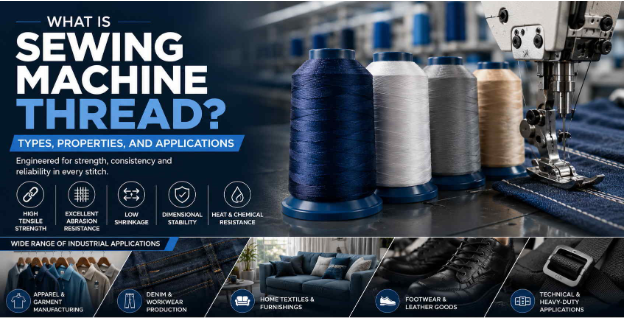
Sewing machine thread is an engineered yarn built to hold stitches reliably under the tension, speed, and friction of a sewing machine. Industrial sewing machine thread relies primarily on polyester, nylon, bonded, and core-spun constructions, each suited to different fabric weights and seam-stress requirements across apparel, home textiles, and technical products.
Every stitched seam depends on more than the sewing machine and the fabric being joined. The thread itself determines how well that seam holds up over time, particularly in industrial production environments where speed, tension, and repeated stress place far greater demands on thread performance than typical home sewing.
Sewing machine thread today is engineered around synthetic fibres such as polyester and nylon, chosen for their strength, consistency, and predictable behaviour on high-speed industrial equipment. Selecting the right thread for sewing machine operations, whether for apparel, home textiles, or heavy-duty products, directly affects seam durability, production efficiency, and finished product quality.
What is Sewing Machine Thread?
Sewing machine thread is a specially engineered yarn designed to form and hold a stitch under the tension, speed, and friction generated by a sewing machine. Unlike general-purpose yarn, sewing thread is manufactured with controlled twist levels, consistent diameter, and a smooth surface finish to feed reliably through machine tensioners, needles, and loopers without breaking or fraying. Industrial sewing machine thread is further engineered for high-speed, continuous production, typically supplied on larger cones and built to tighter strength and consistency tolerances than standard household thread.
Types of Sewing Machine Thread
Polyester Sewing Machine Thread
Polyester thread, available in both spun and continuous filament forms, is the most widely used sewing machine thread across industrial textile manufacturing. It offers a strong balance of tensile strength, low shrinkage, and resistance to fading, making it suitable for the majority of apparel and home textile seams.
Nylon Sewing Machine Thread
Nylon thread offers higher elasticity and abrasion resistance than polyester, along with strong recovery after stretching. This makes it a preferred choice for products subject to repeated flexing or stress, such as footwear, bags, and outdoor equipment.
Bonded Nylon and Polyester Thread
Bonded thread is made by twisting continuous filaments together and coating them with a resin or lubricant that fuses the strands into a smooth, cohesive structure. This bonding improves fray resistance at cut ends, reduces friction during high-speed sewing, and supports heavier-duty applications such as upholstery, canvas, and technical products where seam strength under stress is critical.
Core-Spun Sewing Thread
Core-spun sewing thread is built around a continuous polyester filament core, wrapped with spun polyester or nylon fibre. This construction combines the tensile strength of a filament core with the smoother, more matte surface feel of a spun thread, offering a versatile option across general apparel and industrial sewing applications.
Sewing Machine Thread Types: Key Differences
| Thread Type | Key Characteristics | Typical Applications |
| Polyester Thread | Strength, low shrinkage, colour retention | Apparel, home textiles |
| Nylon Thread | Higher elasticity and abrasion resistance | Footwear, bags, outdoor products |
| Core-Spun Thread | Filament-core strength with spun surface | Apparel and industrial sewing |
Key Properties of Sewing Machine Thread
Tensile Strength and Seam Durability
Tensile strength determines how much stress a seam can withstand before failing. Higher tenacity threads, commonly expressed using tex size or ticket number, reduce seam breakage on high-speed industrial machines and directly extend the usable life of the finished product, which in turn reduces warranty claims and rework on the production line.
Abrasion Resistance
Since thread is repeatedly drawn through the needle, tensioner, and fabric during sewing, resistance to surface wear is essential. Nylon generally offers the strongest abrasion resistance, followed closely by polyester, helping thread maintain strength through both the sewing process and the product’s active use.
Elasticity and Elongation
Elongation describes how far a thread stretches before breaking, usually expressed as a percentage of its original length. Adequate elongation allows a seam to flex with the fabric under stress without snapping, which is particularly important for stretch fabrics and products subject to repeated movement.
Heat and Chemical Resistance
Industrial sewing generates friction-related heat at the needle, and finished products may later face washing, dyeing, or chemical exposure. Polyester and nylon threads, including elior nylon dyed yarn, are engineered to withstand these conditions with minimal strength loss, supporting consistent seam performance through both production and end use.
Applications of Sewing Machine Thread
Apparel and Garment Manufacturing
Polyester and core-spun threads are the standard choice for garment seams, offering the strength, colour retention, and washability required for everyday apparel production.
Denim and Heavy-Duty Garments
Heavier tex and ticket-size polyester or bonded threads are used for stitching denim and other heavy-duty garments, where seams face higher stress during wear and repeated laundering.
Home Textiles and Furnishings
Upholstery, curtains, and soft furnishings typically require bonded or heavier polyester threads capable of withstanding UV exposure, repeated flexing, and long-term mechanical stress.
Footwear and Leather Products
Bonded nylon and polyester threads are widely used in footwear and leather goods, where high abrasion resistance and consistent tensile strength are essential for seams under constant mechanical load.
Also Read: A Complete Guide to Polyester & Nylon Multifilament Yarn
How to Choose the Right Thread for Sewing Machine Operations
- Match the thread’s tex size or ticket number to the fabric weight and seam stress the finished product will face.
- Choose between spun, filament, bonded, or core-spun construction based on the target balance of strength, surface finish, and abrasion resistance.
- Confirm compatibility with your specific sewing machine type and speed, since industrial machines often require tighter tolerances than standard equipment.
- Request tensile strength and elongation data, rather than relying on visual thickness alone, when sourcing for high-stress applications.
- Verify colourfastness and chemical resistance for products that will undergo washing, dyeing, or outdoor exposure.
- Confirm minimum order quantities, cone sizing, and lead times appropriate for continuous industrial production runs.
Evaluating A Sewing Machine Thread Manufacturer
Beyond matching specifications, the supplier’s own consistency matters just as much. Buyers should check whether a manufacturer can hold tight tex and tensile tolerances across production batches, provide test data rather than visual inspection alone, and offer technical support for machine-specific issues such as tension calibration and thread breakage troubleshooting, along with realistic lead times for continuous industrial runs.
Polyester vs Nylon Sewing Machine Thread
| Factor | Polyester Sewing Machine Thread | Nylon Sewing Machine Thread |
| Tensile Performance | High | High |
| Elasticity | Moderate | Generally higher |
| Abrasion Resistance | High | Generally very high |
| Dimensional Stability | Strong | Application-dependent |
| Common Uses | Apparel, home textiles, industrial sewing | Footwear, bags, outdoor products |
| Key Advantage | Strength + low shrinkage | Flexibility + abrasion resistance |
Conclusion
Sewing machine thread plays a far more decisive role in seam performance than its size might suggest. From polyester and nylon threads to bonded and core-spun constructions, each type offers a distinct balance of strength, elasticity, and abrasion resistance suited to specific fabrics and end uses.
Selecting the right thread for sewing machine operations, and verifying its strength and consistency data, remains essential for manufacturers aiming to produce durable seams reliably across apparel, home textile, footwear, and industrial production lines.
Explore AYM Syntex’s range of engineered yarn solutions to discuss polyester, nylon, bonded, and core-spun thread options suited to your production line.
Key Takeaways
- Sewing thread differs from general yarn through controlled twist, consistent diameter, and a smooth finish for reliable machine feeding.
- Four main thread types serve industrial sewing: polyester, nylon, bonded, and core-spun.
- Tensile strength, abrasion resistance, elongation, and heat/chemical resistance together determine seam durability.
- Thread selection should be matched to tex size or ticket number, not visual thickness alone.