
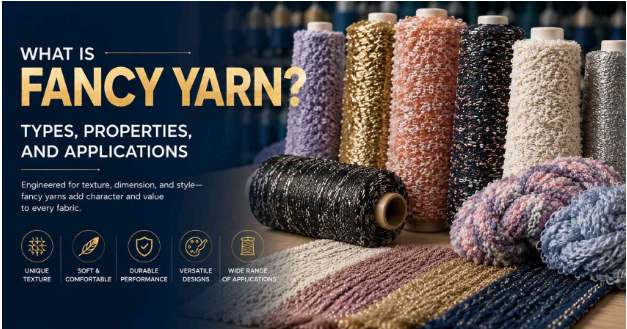
Fancy yarns are deliberately engineered yarns designed with loops, curls, slubs, thickness variations, or other decorative effects to create distinctive texture and visual appeal in finished textiles. Common fancy yarn types include slub, bouclé, chenille, loop/curl, marl, spiral, and gimp yarns. Their performance depends on factors such as yarn construction, overfeed ratio, twist, fibre composition, and structural stability. Choosing the right fancy yarn requires considering the intended application, processing equipment, effect consistency, structural integrity, fibre compatibility, and the capabilities of the fancy yarn manufacturer.
Textile manufacturing has long relied on decorative and structural variation to differentiate finished fabrics in an increasingly design-driven market. As demand grows for fabrics with distinctive texture, dimension, and visual interest, manufacturers continue to look beyond standard yarn constructions to achieve these effects reliably at production scale, without introducing excessive cost or processing risk.
What Is Fancy Yarn?
Fancy yarn refers to a category of yarns deliberately engineered to include irregularities, loops, curls, or thickness variations that create decorative surface effects, rather than the uniform structure of standard yarns. These effects are built into the yarn during manufacturing rather than occurring as processing defects, which is what distinguishes true fancy yarn from yarn that is simply inconsistent in quality.
Most fancy yarn constructions are built from three components: a core yarn that provides the base structure and strength, an effect yarn that creates the decorative feature, and a binder yarn that locks the effect in place once formed. Manufacturers control the overfeed ratio, the rate at which the effect yarn is fed relative to the core, along with twist levels measured in twists per metre, to determine whether the result is a slub, a loop, a curl, or another decorative profile. A higher overfeed ratio typically produces larger, more pronounced loops, while tighter twist control produces a more compact and stable effect.
Different Fancy Yarn Types
Fancy yarn types vary widely based on the manufacturing method used and the decorative effect required.
| Type | Structure | Typical Applications |
| Slub Yarn | Intentional thick-and-thin sections introduced during spinning. | Apparel, denim, and home textiles requiring a textured, organic surface. |
| Bouclé Yarn | Core, effect, and binder yarns combined; effect yarn overfed to form loops away from the yarn body. | Upholstery, cushions, and decorative throws with a pronounced looped texture. |
| Chenille Yarn | Cut from a woven strip to create a soft, velvety pile along the yarn surface. | Upholstery, soft furnishings, and plush textile products. |
| Loop / Curl Yarn | Effect yarn wrapped around the core without initial twist, typically via a hollow spindle machine, for stable loops. | Knitwear and novelty fabrics requiring a stable, controlled loop structure. |
| Marl, Spiral & Gimp Yarn | Two or more differently coloured or textured twisted yarns together. | Knitwear and fashion fabrics requiring subtle colour or texture blending. |
Selecting the correct fancy yarn type depends on the intended fabric construction, since each structure carries different processing requirements and machine compatibility considerations, covered further in the sourcing guidance below.
Also Read: Role of Fashion Threads in Apparel Design, Durability, and Stitch Performance
Key Properties of Fancy Yarn
The value of fancy yarn lies in properties that extend beyond appearance into how the yarn behaves during processing and end use.
-
Superior Texture, Softness & Aesthetic Appeal
The looped or piled structures found in bouclé and chenille yarns increase the yarn’s effective surface area, which enhances softness and creates a distinctive tactile hand feel. Loop size can be engineered from fine, subtle micro-loops to large, sculptural projections, giving manufacturers direct control over how pronounced the textural effect appears on the finished fabric. This textural quality translates directly into a premium visual and physical impression, supporting stronger positioning for home textile and fashion products competing on look and feel rather than price alone, and often commanding a higher per-metre selling price than standard smooth yarns of comparable fibre content.
-
Technical Strength and Processing Consistency
Fancy yarns are engineered as composite structures, typically combining a core yarn that carries the primary tensile load with an effect yarn that forms the loop, slub, or spiral feature. The strength of the core yarn and the binding twist that locks the effect yarn in place determine how reliably the yarn withstands the tension, friction, and repeated flexing encountered during warping, weaving, knitting, and other downstream processes. Consistent count, twist level, and effect placement reduce yarn breakage and irregular effect distribution during production. This structural reliability allows manufacturers to run fancy yarns on standard textile machinery with fewer stoppages, protecting production efficiency and ensuring the decorative effect remains uniform across the length of the yarn and consistent from batch to batch.
-
Lustre and Visual Depth
Lustre in fancy yarn is governed by fibre type, filament cross-section, twist level, and surface structure. Smooth continuous-filament yarns reflect light more directly, producing a brighter, high-sheen appearance, while yarns with irregular surfaces, such as bouclé, chenille, or slub constructions, scatter light more diffusely, creating a softer, matte finish. By selecting or blending fibre types and finishes, manufacturers can engineer a specific lustre level, from high-shine decorative effects to muted, natural-looking textures. This control over light reflection adds visual depth and contrast to the finished fabric, helping brands differentiate coordinated collections and giving manufacturers a further, non-structural lever for premium product positioning.
Applications of Fancy Yarn Across Industries
Fancy yarn serves a broad range of textile sectors where texture and visual distinction are commercially valuable, often justifying a premium position relative to standard smooth yarns.
- Fashion and Apparel: Outerwear, jackets, knitwear, and ties commonly use slub, marl, and loop yarns to add visual and textural interest without requiring elaborate print or embellishment work.
- Home Textiles and Furnishings: Bouclé and chenille yarns are widely used in upholstery, curtains, cushions, and decorative throws, where their looped or piled surface adds both softness and visual depth to accent pieces.
- Carpets and Rugs: Chenille and heavier slub yarns are used in tufted carpet and rug production, where surface texture is a key design feature, though these constructions require tufting machinery with adapted, higher-precision yarn feed systems.
- Hand-Knitting and Craft: Loop, bouclé, and novelty fancy yarns are popular in the hand-knitting and craft yarn market for accessories and decorative projects, where smaller put-ups and a wider colour range are typically expected.
Across these sectors, fancy yarn allows manufacturers to differentiate finished products through texture and visual effect rather than relying solely on colour or print, though each application places different demands on effect consistency and processing speed.
Also Read: Choosing the Right Type of Textured Yarn for Apparel and Industrial Use
How to Choose the Right Fancy Yarn
Selecting the right fancy yarn, and the right fancy yarn manufacturer, requires evaluating both the yarn’s construction and the supplier’s processing capabilities, rather than relying on a swatch card alone.
- Match the fancy yarn type to your processing equipment: bouclé and loop yarns require hollow spindle-compatible machinery, while heavier chenille or slub yarns need robust, lower-speed weaving or tufting setups to avoid warp breakage or dropped stitches.
- Confirm minimum order quantities upfront, since fancy yarn production often carries higher MOQs than standard yarns, sometimes 500kg or more for established effects and considerably higher for custom developments, and typically runs 30-70% slower than standard yarn production.
- Request effect uniformity data, checking that slub or loop size and frequency remain consistent across multiple cones in a batch rather than only in the sample provided.
- Verify structural integrity through loop pull-out resistance testing for bouclé and chenille yarns, along with standard tensile strength evaluation, particularly for upholstery and carpet applications subject to ongoing mechanical stress.
- Confirm base fibre and blend options, along with colourfastness performance, for the intended end use and market, since fibre choice affects both hand feel and washing or light-fastness behaviour.
- Avoid selecting a fancy yarn based on a visual sample alone; confirm its compatibility with your specific weaving, knitting, or tufting process before committing to a production order, since irregular yarn structures that are not properly matched to machine settings can cause warp breakage, dropped stitches, or uneven fabric.
A dependable fancy yarn manufacturer should be able to provide clear data on effect consistency, structural testing, and machine compatibility rather than relying on visual samples alone, along with realistic lead times given the additional process steps fancy yarn production typically involves.
Future Trends in Fancy Yarn Manufacturing
Fancy yarn manufacturing continues to evolve alongside broader textile industry trends. Increasing use of recycled and blended fibre bases is extending sustainability considerations into decorative yarn categories, while air-jet texturing methods are reducing mechanical wear and yarn breakage compared to traditional twisting processes.
Electronic feed and tension control systems are also improving effect uniformity at production scale, allowing manufacturers to hold tighter tolerances on slub and loop consistency than earlier mechanical setups permitted. This is helping manufacturers meet growing demand from both fashion and home décor markets, as well as the expanding hand-knitting and craft yarn segment, where buyers increasingly expect the same batch consistency historically associated with standard, non-fancy yarns.
Also Read: Advantages of Synthetic Yarn Over Natural Yarn
Conclusion
Fancy yarn plays a distinctive role in textile manufacturing by translating deliberate structural variation into commercially valuable texture and visual appeal. From slub and marl yarns to bouclé, chenille, and loop constructions, the range of available fancy yarn types allows manufacturers to match the right structure to the right fabric and application, whether the goal is a subtle textured hand feel or a pronounced, sculptural surface effect.
Choosing the correct fancy yarn type, verifying its structural and processing performance, and partnering with a fancy yarn manufacturer capable of consistent effect quality remain essential for achieving reliable texture, durability, and product differentiation across production runs. As demand for textured and novelty fabrics continues to grow across apparel, home textiles, and craft markets, manufacturers who invest in understanding fancy yarn properties and sourcing practices will be better positioned to meet evolving design expectations without compromising on production efficiency.
Key Takeaways
- Fancy yarn is deliberately engineered to create decorative textures and surface effects rather than being irregular due to manufacturing defects.
- Common fancy yarn types include slub, bouclé, chenille, loop/curl, marl, spiral, and gimp yarns, each offering different structural and visual effects.
- Core, effect, and binder yarns are commonly combined to create and stabilize fancy yarn structures, with overfeed and twist influencing the final effect.
- Key fancy yarn properties include texture, softness, aesthetic appeal, structural stability, durability, and compatibility with different fibre types.
- Fancy yarns are used across apparel, home textiles, upholstery, carpets, rugs, and hand-knitting/craft applications.
- Selecting the right fancy yarn requires evaluating yarn construction, machine compatibility, effect consistency, fibre composition, colourfastness, and end-use requirements.
- Buyers should assess a fancy yarn manufacturer based on structural testing, effect consistency, machine compatibility, quality assurance, and reliable production capabilities.
- Emerging technologies such as electronic feed and tension control, air-jet texturing, recycled fibres, and blended fibre constructions are supporting greater consistency and flexibility in fancy yarn manufacturing.