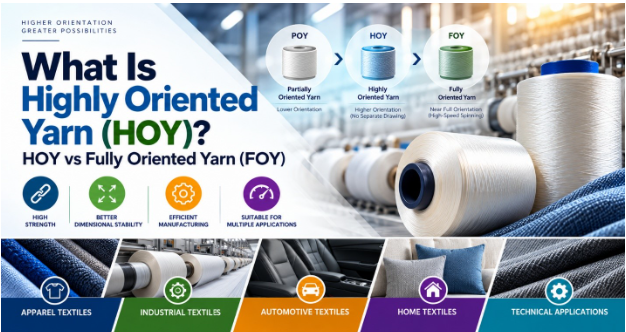
Highly Oriented Yarn (HOY) is a synthetic filament yarn produced through high-speed melt spinning, which generally achieves a greater degree of molecular orientation than Partially Oriented Yarn (POY) without passing through a separate mechanical drawing step. Fully Oriented Yarn (FOY) is produced at higher spinning speeds still, reaching a level of molecular orientation that approaches, and in some production setups matches, the orientation achieved through conventional drawing. Note that terminology and classification for FOY and FDY are not fully standardized across the industry, and different manufacturers may use these terms somewhat differently, so the distinction described in this article should be treated as a general framework rather than a universal definition. Understanding where HOY and FOY generally sit between POY and FDY can help manufacturers evaluate filament yarn options for weaving, knitting, and blending applications, though actual yarn performance should always be confirmed against the specific supplier’s technical specifications.
What Is Highly Oriented Yarn (HOY)?
As manufacturers look for ways to reduce processing steps while maintaining consistent yarn quality, spinning speed has become one of the most important variables in filament yarn manufacturing, directly influencing how much molecular orientation a yarn achieves during spinning itself.
Highly Oriented Yarn, commonly abbreviated as HOY, is a synthetic filament yarn produced by spinning the polymer melt at a higher speed than conventional POY production, which increases the degree of molecular orientation achieved as the filament is drawn down and solidified. Unlike Fully Drawn Yarn, which reaches its final orientation through a dedicated mechanical drawing step after spinning, HOY achieves a meaningfully higher orientation level directly from the spinning process, without that separate drawing stage.
This higher in-line orientation generally gives HOY intermediate mechanical properties, often stronger and more dimensionally stable than POY, though typically not matching the tenacity and low elongation of fully drawn or fully oriented yarn. These are general tendencies rather than fixed outcomes: actual tenacity, elongation, and stability also depend on the polymer type, specific spinning conditions, and the yarn specification being produced, so figures should be confirmed against the relevant technical data sheet rather than assumed from orientation level alone.
What Is Fully Oriented Yarn (FOY)?
Fully Oriented Yarn, or FOY, is generally produced by spinning the polymer melt at a higher speed than HOY, to the point where the molecular orientation achieved during spinning approaches, or in some production setups effectively reaches, full orientation without requiring a separate drawing step.
It is worth noting that FOY and Fully Drawn Yarn (FDY) are not always treated as strictly separate manufacturing routes across the industry. Some manufacturers distinguish FOY as yarn that reaches full orientation through high-speed spinning alone, reserving the FDY designation for yarn that reaches full orientation via a distinct spin-then-draw sequence. Other manufacturers use FOY and FDY more interchangeably, applying the FDY designation to any yarn that has reached full molecular orientation, regardless of whether that orientation was achieved through spinning speed, mechanical drawing, or a combination of both. Because of this variation, buyers should confirm how a specific supplier defines and classifies FOY and FDY rather than assuming a fixed, universal distinction.
Where FOY’s orientation level is close to that of conventionally drawn yarn, its tenacity and elongation characteristics are often comparable to Fully Drawn Yarn, though actual values depend on the polymer type, spinning conditions, and the specific yarn grade. In setups where high-speed spinning achieves this orientation without a separate drawing step, FOY can offer an efficient route to a fully oriented, ready-to-use filament yarn.
Also Read: Differences between POY vs FDY
How Highly Oriented Yarn Is Produced
The production outline below describes the general principle behind HOY manufacturing. Exact spinning speeds, equipment configurations, and process details vary across manufacturers and polymer systems, so this should be read as an illustration of the underlying mechanism rather than a fixed specification that applies identically to every HOY product.
High-speed melt spinning
HOY production begins the same way as other synthetic filament yarns, with polymer chips melted and extruded through a spinneret to form continuous filaments. A key factor is the take-up speed at which the filaments are wound after extrusion. Conventional POY is typically wound at a comparatively moderate speed, while HOY is generally spun and wound at a higher speed. This higher take-up speed tends to increase the drawdown stress the filament experiences as it cools and solidifies, which in turn can increase the degree of molecular alignment achieved before the yarn is wound onto a package.
Molecular orientation without a separate drawing step
In conventional FDY production, filaments are typically spun at a moderate speed and then passed through a distinct drawing stage, where heated godet rollers mechanically stretch the yarn to align its polymer chains. HOY production is generally understood to achieve a meaningful share of that same molecular alignment during spinning itself, as a result of spinning speed, rather than through this additional mechanical step. This can allow HOY to reach a higher orientation level than POY while keeping the production process shorter than the conventional two-step spin-and-draw route, though HOY typically still falls short of the full orientation achieved by FOY or FDY. As with other aspects of this topic, the precise orientation level achieved depends on the specific polymer, equipment, and process parameters used.
Also Read: How Polyester Synthetic Filament Yarns Are Made
Highly Oriented Yarn vs Fully Oriented Yarn: Key Differences
HOY and FOY both originate from high-speed spinning rather than conventional mechanical drawing, but the spinning speed used, and the resulting orientation level, separate the two.
Spinning speed and orientation level
HOY is generally produced at a high spinning speed that raises molecular orientation above POY, but typically stops short of full orientation. FOY is generally produced at a higher spinning speed still, sufficient in many cases to bring molecular orientation close to, or in line with, fully drawn yarn, without requiring a separate drawing step. The specific speed thresholds that separate these categories are not fixed industry-wide and can vary by polymer type and equipment, so this should be understood as a general tendency rather than a precise numeric boundary.
Strength and elongation
Because FOY generally reaches a higher orientation level than HOY, it often offers higher tenacity and lower elongation, trending closer to FDY performance. HOY typically sits between POY and FOY on both measures, often showing improved strength and reduced elongation relative to POY, while not necessarily reaching FOY or FDY-level stability. These are general tendencies associated with orientation level rather than fixed outcomes: actual tenacity and elongation also depend on polymer type, processing conditions, and the specific yarn specification, and should be verified against the relevant technical data sheet for a given product.
Shrinkage and dyeing behaviour
Lower-orientation yarns generally tend toward higher shrinkage potential and different dye uptake characteristics than fully oriented yarns, since less-oriented polymer chains typically respond differently to heat and dye penetration. HOY, with its intermediate orientation, often shows shrinkage and dyeing behaviour between POY and FOY, while FOY’s higher orientation can support more predictable shrinkage and more consistent dye uptake, trending closer to what is typically expected from fully drawn yarn. As with the mechanical properties above, actual shrinkage and dyeing performance depend on polymer type, processing and heat-setting conditions, and the specific application, and should be confirmed through testing or supplier data rather than assumed from orientation level alone.
Also Read: How to Choose the Right Yarn for Your Project?
Where HOY and FOY Fit Alongside POY and FDY
POY, HOY, FOY, and FDY can be understood as points along the same orientation spectrum, distinguished primarily by spinning speed and whether a separate drawing step is used.
POY is generally spun at the lowest relative speed among this group, producing the least molecular orientation and requiring further processing, typically draw-texturing, before use. HOY is spun at a higher speed than POY, generally achieving greater in-line orientation while still falling short of full orientation. FOY is spun at a higher speed still, reaching an orientation level that approaches full orientation without a separate draw step in many production setups. FDY is conventionally associated with reaching full orientation through a distinct two-step process, spinning at a moderate speed followed by dedicated mechanical drawing, though, as noted above, some manufacturers apply the FDY designation more broadly to any yarn that reaches full orientation, regardless of the specific route used.
Also Read: Differences between Partially Oriented Yarn vs Fully Drawn Yarn
Manufacturers choose between these yarn types based on the balance they need between production efficiency, orientation level, and downstream processing requirements, since each represents a different route to, or distance from, full molecular orientation.
| Yarn Type | Relative Spinning Speed | Separate Drawing Step | Orientation Level |
| POY | Lowest | Not applicable (needs further processing) | Lowest |
| HOY | Higher than POY | No | Intermediate |
| FOY | Higher than HOY | No (in most setups) | Approaches full orientation |
| FDY | Moderate | Yes | Full orientation |
Note: these are general tendencies, not fixed industry-wide thresholds. Confirm classification and orientation level against the specific supplier’s technical data.
Applications of Highly Oriented Yarn
The application areas below illustrate common possibilities for HOY based on its general property profile. They are not universal recommendations: actual suitability depends on the specific yarn grade, denier, and the technical requirements of the intended fabric or process, and should be confirmed against the relevant specification before selection.
Weaving and warp knitting
HOY’s improved strength and reduced elongation relative to POY can make it a suitable option for weaving and warp knitting applications where a degree of dimensional stability is required, though applications demanding maximum strength and minimal elongation would typically be evaluated against FOY or FDY as well. AYM Syntex’s Textile Yarns range covers POY, HOY, FDY, and DTY options across these applications.
Lining and dress fabrics
The intermediate orientation of HOY can support fabrics requiring a balance of drape and stability, making it a possible choice for linings and dress fabrics where a smooth, moderately stable filament yarn is appropriate, subject to confirming the specific yarn’s properties against the fabric’s requirements.
Blending with other filament yarns
HOY can potentially be blended or combined with other filament yarn types during fabric construction, allowing manufacturers to combine its strength and elongation profile with the characteristics of POY, FOY, or FDY to work toward a specific fabric performance outcome, with final suitability confirmed through trial or technical evaluation.
Also Read: What Is Polyester Thread?
Conclusion
Highly Oriented Yarn and Fully Oriented Yarn both represent high-speed spinning routes to molecular orientation that generally sit between POY and conventionally drawn FDY, differentiated primarily by spinning speed and the resulting degree of orientation achieved without a separate drawing step. Because terminology and production routes for FOY and FDY are not fully standardized across the industry, these distinctions should be treated as a general framework rather than a fixed definition. Understanding how HOY and FOY generally compare in strength, elongation, and shrinkage behaviour, and how they fit alongside POY and FDY, can help manufacturers evaluate filament yarn options for weaving, knitting, or blending requirements, with final selection confirmed against the specific supplier’s technical specifications rather than orientation category alone.