Fabric manufacturers and garment brands sourcing dyed polyester yarn are often faced with a basic but consequential choice early in the sourcing process: should the fabric be built on FDY dyed yarn or DTY dyed yarn? The decision affects more than just the shade on the shade card. It shapes how the finished fabric looks on the shelf, how it feels against the skin, how it behaves during stitching and finishing, and ultimately how satisfied the end customer is with the garment.
Both FDY dyed yarn and DTY dyed yarn start from the same base polymer family, but the way each yarn is drawn and textured during manufacturing changes its surface, its stretch behaviour, and the finish it gives to polyester dyed yarn based fabrics. This article explains what each yarn type is, how dyed polyester yarn is produced, where FDY dyed and DTY dyed yarn differ in practice, and how manufacturers can decide which one fits a given fabric or application.
What Is FDY Dyed Yarn?
FDY dyed yarn is Fully Drawn Yarn that has been dyed, typically through a package dyeing process, after the filament has already been drawn to its final, fully oriented state. Because Fully Drawn Yarn is drawn in a single continuous spinning-and-drawing sequence, its filaments are smooth, straight, and consistently oriented along their length, without the mechanical texturing that crimped or textured yarns go through.
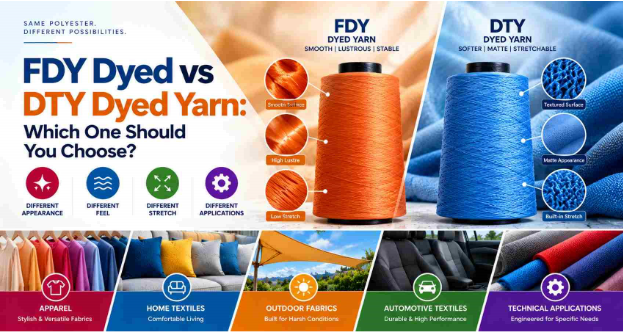
This straight-filament structure is what gives FDY dyed yarn its characteristic appearance: a smooth, lustrous surface with relatively low bulk and minimal inherent stretch. When dyed, this smoothness also affects how light reflects off the yarn surface, which is why FDY dyed fabrics are generally associated with a cleaner, more lustrous visual finish than textured yarn equivalents. FDY dyed yarn is commonly specified by denier, filament count, and shade, with the fully oriented, undrawn-free structure making it a dimensionally stable choice for applications where a smooth, stable yarn is preferred over stretch or bulk.
What Is DTY Dyed Yarn?
DTY dyed yarn is Draw Textured Yarn that has gone through an additional texturing stage, where the yarn is false-twisted and heat-set to introduce crimp, bulk, and stretch into the filament structure, before being dyed. This texturing step is what fundamentally separates DTY from FDY: rather than remaining straight and flat, the filaments in DTY are permanently crimped, which traps air between filaments and gives the yarn a softer hand-feel and a degree of built-in elasticity that FDY does not have.
Because the crimped filament surface scatters light differently than a straight filament, DTY dyed yarn generally presents a softer, more matte visual finish compared with the higher lustre of FDY dyed yarn, even when both are dyed to the same shade. DTY dyed yarn is typically specified by denier, filament count, texturing type, and shade, and is widely used where fabric stretch, bulk, and a softer surface feel are priorities, making it a frequent choice across apparel and dyed yarns for apparel and fashion applications.
How Dyed Polyester Yarn Is Produced
Dyed polyester yarn, whether built on an FDY or DTY base, generally reaches manufacturers through a package dyeing process that colours the yarn after spinning and, in the case of DTY, after texturing, rather than through the dope-dyeing route where pigment is added to the polymer melt before extrusion. Understanding this process matters to manufacturers because the dyeing method and the quality controls applied at this stage directly influence shade consistency, colour fastness, and how predictably a dye lot will perform once it reaches the loom or knitting machine.
Package dyeing process
In package dyeing, wound yarn packages, cones or cheeses carrying the FDY or DTY base yarn are loaded into a dyeing machine, where dye liquor is circulated under controlled temperature and pressure so that it penetrates evenly through the layers of yarn on each package. Because dye uptake depends on the yarn’s filament structure, FDY’s smooth, straight filaments and DTY’s crimped, textured filaments can behave somewhat differently during this process, with texturing generally increasing the surface area available for dye absorption. This is why dye recipes and process parameters are typically adjusted based on the specific base yarn type rather than applied identically across FDY and DTY.
Colour matching and quality checks
After dyeing, each batch is checked against a reference shade standard under controlled lighting conditions to confirm colour accuracy, and samples are typically tested for colour fastness to washing, rubbing, and light exposure using standardized methods such as those under the ISO 105 series. These checks matter at a manufacturing level because even small shade variations between dye lots can create visible inconsistency across a finished fabric roll or a garment production run, so manufacturers sourcing dyed polyester yarn should confirm a supplier’s shade-matching tolerances and testing protocols before committing to a bulk order.
Also Read: Differences between Partially Oriented Yarn (POY) vs Fully Drawn Yarn (FDY)
FDY Dyed vs DTY Dyed: Key Differences
While both are forms of dyed polyester yarn produced from the same base polymer, FDY dyed and DTY dyed yarn differ in filament structure, and that structural difference carries through to how each performs and appears in a finished fabric.
Shine and smoothness
FDY dyed yarn’s straight, untextured filaments reflect light more uniformly, which generally gives FDY dyed fabrics a smoother surface and a more pronounced shine or lustre. DTY dyed yarn’s crimped filament structure scatters light rather than reflecting it evenly, which generally produces a softer, more matte appearance. Manufacturers targeting a glossy, satin-like fabric finish would generally lean toward FDY dyed yarn, while those targeting a subdued, non-reflective surface would generally lean toward DTY.
Stretch and softness
Because DTY dyed yarn is permanently crimped during texturing, it generally offers inherent stretch and recovery that FDY dyed yarn, with its straight, fully drawn filaments, does not provide on its own. The same crimped structure also traps air between filaments, which generally contributes to a softer hand-feel in DTY dyed fabrics compared with the smoother, firmer feel typical of FDY dyed fabrics.
Fabric look and feel
Taken together, these structural differences mean FDY dyed yarn generally suits fabrics where a smooth, lustrous, stable surface is the priority, while DTY dyed yarn generally suits fabrics where stretch, bulk, and a soft, textured hand-feel are the priority. Actual fabric outcomes still depend on construction, finishing, and blend ratios, so these are general tendencies rather than fixed rules.
Also Read: Polyester Spun Yarn vs. Polyester Textured Yarn
| Factor | FDY Dyed Yarn | DTY Dyed Yarn |
| Filament structure | Straight, fully drawn | Crimped, textured |
| Surface appearance | Smooth, higher lustre | Softer, more matte |
| Stretch and recovery | Minimal inherent stretch | Built-in stretch from crimp |
| Hand-feel | Smoother, firmer | Softer, bulkier |
| Dimensional stability | Generally higher | Generally lower, more elastic |
| Typical priority | Shine, smoothness, stability | Stretch, softness, bulk |
Uses of FDY Dyed Yarn
FDY dyed yarn’s smooth, lustrous, dimensionally stable structure makes it a frequent choice for applications where a clean fabric surface and consistent shade retention matter more than stretch, such as lining fabrics, formal apparel, and certain home textile constructions where a smooth, lustrous finish supports the intended aesthetic. Its lower elongation and stable filament structure also make it a workable option in woven constructions where dimensional consistency across the fabric width is important for downstream cutting and stitching operations.
Uses of DTY Dyed Yarn
DTY dyed yarn’s built-in stretch, bulk, and softer surface make it a common choice for knitted apparel, activewear, and other fabrics where comfort, recovery, and a soft hand-feel are priorities, which is why it is widely used across performance and active wear and broader apparel and fashion dyed-yarn applications. The added bulk from texturing can also help a fabric achieve better coverage and opacity at a given weight compared with an equivalent FDY construction, which manufacturers sometimes use to manage fabric cost and feel together.
Also Read: How to Choose Packaged Dyed vs Solution Dyed Yarns?
How to Choose the Right Polyester Dyed Yarn
Choosing between FDY dyed and DTY dyed yarn should start with the fabric’s end-use requirements rather than cost or availability alone. Manufacturers evaluating polyester dyed yarn for a new fabric or garment programme should consider the finish the design calls for, since a lustrous, smooth surface points toward FDY while a soft, matte surface points toward DTY. Stretch and recovery requirements matter just as much: applications needing fabric elasticity, such as activewear or form-fitting apparel, are generally better supported by DTY, while applications prioritizing dimensional stability and crease resistance lean toward FDY.
Shade consistency and colour fastness requirements should also be confirmed against the specific dye lot and testing data for the chosen base yarn, since dye uptake and fastness performance can vary between FDY and DTY structures. Finally, manufacturers should weigh end-use comfort expectations, such as how the fabric will feel against the skin during extended wear, against the visual and technical requirements, since FDY and DTY each offer a different balance of these factors rather than one being universally superior. For a closer look at how packaged dyeing compares with solution dyeing more broadly, see AYM Syntex’s guide on Packaged Dyed vs Solution Dyed Yarns.
Conclusion
FDY dyed and DTY dyed yarn both deliver dyed polyester yarn built on the same base polymer, but their different filament structures, straight and fully drawn in FDY, crimped and textured in DTY, lead to distinct outcomes in shine, stretch, softness, and overall fabric feel. Manufacturers choosing between the two should match the yarn’s structural strengths to the fabric’s intended finish and performance requirements, rather than treating FDY and DTY as interchangeable options, and should confirm dyeing quality, shade consistency, and colour fastness data against their specific application before finalizing a sourcing decision.