What Is UV Yarn?
UV yarn is a general term for synthetic filament yarn that has been engineered to resist the degrading effects of ultraviolet radiation during prolonged outdoor or high-light exposure. Standard synthetic yarns are not inherently immune to UV exposure, and over time, sunlight can affect both the appearance and the mechanical performance of untreated fibre. UV yarn addresses this by incorporating protective measures, typically at the polymer or dyeing stage, that slow the rate at which ultraviolet radiation breaks down the fibre’s structure.
The term UV yarn can apply to several polymer types, including polyester, polypropylene, and nylon, though UV-treated polyester yarn is among the most common because of polyester’s broader use in outdoor textile applications such as awnings, shade structures, and technical fabrics.
How UV Rays Damage Yarn and Fabric
Ultraviolet radiation carries enough energy to break certain chemical bonds within a polymer’s molecular structure, a process generally referred to as photodegradation. The extent of this damage depends on factors such as exposure duration, climate, altitude, and the specific polymer and additive formulation involved, so outcomes can vary meaningfully between applications and geographic conditions.
Colour fading
Repeated UV exposure can break down the chemical structures responsible for colour in dyed or pigmented fibre, which generally presents as gradual fading, dulling, or uneven colour change over time. The rate and visibility of this fading depend on the dye or pigment type, the depth of shade, and the fabric’s exposure conditions, so colour fastness performance should be evaluated for the specific yarn and application rather than assumed uniformly across all UV-exposed textile yarns.
Loss of strength
Beyond colour change, UV exposure can also degrade the polymer chains that give fibre its tensile strength, which may lead to increased brittleness and reduced tear or burst strength over extended exposure periods. This mechanical degradation typically occurs more gradually than visible colour fading, meaning a fabric can sometimes retain reasonable strength even as its colour begins to change, or conversely show strength loss before fading becomes clearly visible, depending on the polymer and stabilization approach used.
How UV Yarn Prevents Fading
UV yarn is generally produced using one, or a combination, of approaches intended to slow photodegradation and reduce visible fading, rather than eliminate UV effects entirely. No UV-treated yarn is permanently immune to ultraviolet exposure; the goal of UV stabilization is to extend service life and delay visible degradation under defined exposure conditions.
UV stabilisers added to the polymer
UV-stabilizing additives, such as hindered amine light stabilizers or UV absorbers, can be incorporated into the polymer before or during extrusion. These additives generally work by absorbing ultraviolet energy or interrupting the degradation reactions it triggers within the polymer, which can meaningfully slow the rate of both colour fading and mechanical degradation. The specific additive type, concentration, and how evenly it is dispersed through the polymer all influence how effective this protection is in practice.
Dope dyeing for better light fastness
In dope dyed yarn solution, pigment is added directly into the polymer melt before extrusion rather than applied to the finished fibre surface afterward. Because the pigment becomes embedded throughout the fibre cross-section rather than sitting primarily at the surface, dope-dyed yarn can generally offer improved light fastness compared with certain conventional dyeing methods, since there is more pigment mass available to resist UV-driven fading. Actual light fastness performance still depends on the specific pigment system and polymer formulation used.
| Stabilization Method | How It Works | Applied At | Typical Light-Fastness Benefit |
| UV-stabilizing additives | Absorb UV energy or interrupt degradation reactions in the polymer | Before or during extrusion | Slows colour fading and mechanical degradation |
| Dope dyeing (solution dyeing) | Embeds pigment through the fibre cross-section, not just the surface | Added to the polymer melt before extrusion | Improved light fastness vs. surface-applied dyeing |
Note: actual performance depends on the specific additive, pigment system, and polymer formulation used; confirm against supplier test data.
Also Read: Packaged Dyed vs Solution Dyed Yarns
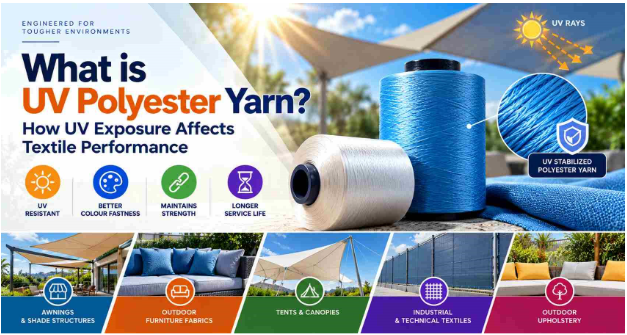
What Is UV Polyester Yarn?
UV polyester yarn refers specifically to polyester filament yarn that has been produced with UV-stabilizing measures, whether through stabilizing additives, dope dyeing, or a combination of both, to improve its resistance to ultraviolet degradation relative to standard, untreated polyester yarn. Because polyester is already a relatively durable synthetic fibre, UV stabilization is generally applied to extend that durability specifically under sustained outdoor light exposure, rather than to address a weakness unique to polyester as a polymer.
UV polyester yarn is typically specified by denier, filament count, pigment or stabilizer system, and the UV performance level required for the intended application, since these variables together determine how the yarn will perform under real-world exposure conditions.
Benefits of UV Yarn
Extended service life under outdoor exposure. UV yarn is generally engineered to maintain its colour and mechanical properties for longer under sustained sunlight exposure than untreated yarn, supporting longer product lifecycles in outdoor applications.
More predictable colour performance. Because UV stabilization and dope dyeing can reduce the rate of visible fading, UV yarn generally supports more consistent colour appearance over the product’s service life, which can matter for applications with strict aesthetic or brand-colour requirements.
Retained mechanical performance. By slowing UV-driven polymer degradation, UV yarn can help fabric retain a greater share of its tensile strength over time compared with untreated yarn exposed to similar conditions.
Application-specific engineering. UV protection level, pigment system, and polymer grade can all be adjusted to match the expected exposure severity and service life of a given application, allowing manufacturers to balance performance against cost rather than over-specifying a single universal UV grade.
Also Read: Advantages of Dope Dyed Yarn
Applications of UV Polyester Yarn
Outdoor furniture and awnings
UV polyester yarn is commonly used in outdoor furniture textiles and awning fabrics, where sustained sun exposure over multiple seasons makes colour retention and mechanical durability important performance considerations.
Shade nets and agro textiles
Shade netting and other agricultural textiles are frequently exposed to prolonged, direct sunlight, making UV-stabilized yarn a relevant consideration for maintaining both the structural integrity and functional performance of these products over their intended service life.
Automotive and marine fabrics
Automotive interior and exterior textiles, along with marine fabrics exposed to sun and salt air, can benefit from UV-stabilized polyester yarn, though the specific UV grade and any additional protective treatments should be matched to the particular exposure conditions of the application.
Also Read: The Complete Guide to Polyester Yarn and Its Uses
How UV Resistance Is Tested
UV resistance in yarn and fabric is generally assessed using standardized accelerated weathering tests, which expose samples to controlled ultraviolet light, heat, and sometimes moisture cycles over a defined period to simulate long-term outdoor exposure in a shorter timeframe. Common reference standards in this area include methods such as those published under the ISO 105 series for colour fastness to light, alongside accelerated weathering approaches such as xenon-arc or UV-fluorescent exposure testing.
Because accelerated testing conditions do not perfectly replicate every real-world climate or exposure scenario, results should be interpreted as a comparative performance indicator rather than an exact prediction of service life in a specific location or application. Buyers evaluating UV polyester yarn should request test data relevant to the specific standard, exposure duration, and conditions used, and confirm these align with their application’s actual requirements.
Conclusion
UV polyester yarn is engineered to slow, rather than eliminate, the colour fading and strength loss that ultraviolet exposure can cause in synthetic fibre, using approaches such as UV-stabilizing additives and dope dyeing to extend service life under sustained outdoor conditions. Because UV performance depends on the specific polymer formulation, stabilizer system, and testing conditions involved, manufacturers and procurement teams should evaluate UV yarn against application-specific exposure requirements and verified test data rather than treating UV resistance as a single uniform property.