What is Open End Yarn? Process and Structural Overview
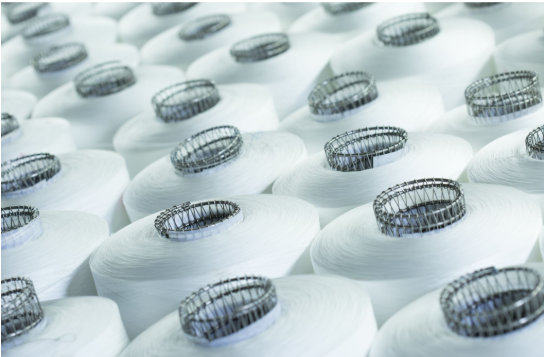
Open end yarn is a type of spun yarn manufactured using rotor spinning technology instead of traditional ring spinning. In this process, fibres are separated into individual strands and collected inside a rotor where yarn formation takes place continuously.
Unlike conventional spinning systems that require multiple intermediate stages, open end spinning combines twisting and winding into a single operation. This allows manufacturers to achieve higher production speeds and improved operational efficiency, especially in large-scale textile manufacturing environments.
Open end yarn is commonly produced using cotton, polyester, viscose, recycled fibres, and blended materials, depending on the application requirements.
Open End Spinning Technology: Rotor-Based Yarn Formation
Open end spinning operates through a rotor-based yarn formation system. The process begins with sliver feed, where fibres are opened and transported through airflow into a high-speed rotor chamber. Inside the rotor:
- Fibres collect along the rotor groove
- Centrifugal force aligns the fibres
- Continuous twisting forms the yarn structure
- Yarn is simultaneously wound into packages
Modern rotor spinning machines operate at extremely high rotor speeds, enabling significantly greater production output compared to ring spinning systems.
Because fewer mechanical stages are involved, open end spinning also reduces machine complexity and improves manufacturing continuity.
Also read: What is Yarn Spinning Process
Open End Yarn vs Open End Spun Yarn: Is There a Difference?
In industrial textile terminology, the terms open end yarn and open end spun yarn generally refer to the same category of yarn.
Both terms describe yarn manufactured using open end rotor spinning technology rather than ring spinning. However, “open end spun yarn” is sometimes used in technical discussions to show that the yarn belongs to the spun yarn category rather than filament yarns. In practical textile manufacturing and sourcing, the terms are used interchangeably.
Structural Characteristics Compared to Ring Spun Yarn
The fibre arrangement in open end yarn differs considerably from ring spun yarn due to the rotor spinning mechanism.
Structural Factor |
Open End Yarn |
Ring Spun Yarn |
| Fibre orientation | Less parallel | More parallel |
| Yarn structure | Bulkier and more open | Compact and dense |
| Surface appearance | Uniform and matte | Smooth and refined |
| Hairiness | Lower | Higher |
| Twist distribution | Rotor-based wrapping | Continuous twist insertion |
These structural differences influence yarn behaviour during weaving, knitting, dyeing, and end-use performance.
Open End Yarn vs Ring Spun Yarn: Key Differences
Open end yarn and ring spun yarn are designed for different manufacturing priorities and fabric requirements.
Performance Parameter |
Open End Yarn |
Ring Spun Yarn |
| Production speed | Very high | Lower |
| Labour requirement | Lower | Higher |
| Yarn count suitability | Medium to coarse counts | Fine to medium counts |
| Yarn uniformity | High | Moderate |
| Tensile strength | Moderate | Higher |
| Bulk characteristics | Higher bulk | Lower bulk |
| Manufacturing cost | Lower | Higher |
| Typical applications | Denim, towels, industrial fabrics | Premium apparel, fine fabrics |
Because of its productivity and operational advantages, open end yarn is widely preferred in high-volume textile manufacturing sectors.
Refer: How to Select Synthetic Yarn: The Advantages of Polyester and Spun Yarn
Key Open End Yarn Properties Driving Industrial Adoption
The growing industrial use of open end spun yarn is strongly linked to its process stability, production consistency, and manufacturing efficiency.
Yarn Uniformity and Evenness in Large-Scale Production
Rotor spinning enables better yarn regularity by distributing fibres evenly within the rotor chamber during yarn formation. This improved evenness helps manufacturers achieve:
- More consistent fabric appearance
- Reduced thick and thin places
- Better machine efficiency
- Lower defect rates during weaving and knitting
- Improved dye uniformity in finished fabrics
In large-scale production environments, yarn consistency becomes essential for maintaining stable output quality across multiple manufacturing batches.
Lower Hairiness and Improved Processability
Open end yarn generally exhibits lower hairiness compared to ring spun yarn because many surface fibres become wrapped around the yarn body during rotor spinning. Lower hairiness contributes to:
- Reduced lint generation
- Cleaner processing environments
- Lower yarn breakage rates
- Improved weaving performance
- Better abrasion behaviour during fabric manufacturing
These processability advantages are particularly important in automated textile plants operating at high machine speeds.
Strength, Bulk, and Absorbency Characteristics
Open end yarn offers a balance of strength, bulk, and absorbency suitable for many industrial and commercial textile applications.
Property |
Industrial Impact |
| Moderate tensile strength | Suitable for medium-duty textile applications |
| Higher bulk structure | Improves fabric coverage and softness |
| Better absorbency | Useful for towels and cleaning textiles |
| Stable yarn geometry | Supports process consistency |
| Controlled porosity | Enhances comfort and moisture behaviour |
Although ring spun yarn generally provides higher tensile strength, open end yarn delivers better productivity and cost efficiency in many coarse and medium-count applications.
Productivity Advantages in High-Volume Manufacturing
One of the biggest reasons for the adoption of open end spinning is its productivity advantage. Compared to ring spinning:
- Production speeds are significantly higher
- Fewer processing stages are required
- Larger yarn packages reduce machine stoppages
- Automation compatibility improves efficiency
- Operator dependency is reduced
These advantages allow textile manufacturers to increase production capacity while maintaining consistent yarn quality. Rotor spinning systems are particularly effective in manufacturing environments where continuous production and high throughput are critical.
Cost Efficiency of Open End Spun Yarn
Open end spun yarn is widely considered cost-efficient for bulk textile manufacturing. Several operational factors contribute to lower production costs:
Cost Factor |
Manufacturing Benefit |
| Simplified spinning process | Reduced operational complexity |
| Higher machine productivity | Lower cost per kilogram |
| Reduced labour requirement | Lower manpower expenses |
| Faster production cycles | Improved manufacturing efficiency |
| Recycled fibre compatibility | Better raw material flexibility |
The ability to process recycled and reclaimed fibres efficiently also makes open end spinning increasingly relevant in cost-sensitive and sustainability-focused textile production systems.
Also read: Six Advantages of Recycled Polyester Yarn
Industrial Applications of Open End Yarn
Open end yarn is used across multiple textile and industrial manufacturing sectors where durability, productivity, and cost control are important. Common applications include:
| Denim fabrics | Towels and bath textiles | Socks |
| T-shirts and knitwear | Upholstery fabrics | Industrial wiping cloths |
| Home textiles | Workwear fabrics | Cleaning textiles |
Medium and coarse-count yarns produced through rotor spinning are especially suitable for products requiring bulk, absorbency, and dimensional stability.
Explore: Comfeel Denim Yarn
How to Select the Right Open End Yarn for Manufacturing
Selecting the appropriate open end yarn depends on the intended manufacturing process and final product requirements. Manufacturers and buyers typically evaluate:
- Fibre composition
- Yarn count
- Evenness and uniformity
- Absorbency requirements
- Tensile strength
- Dyeing compatibility
- Process performance during weaving or knitting
- End-use durability requirements
Supplier consistency and contamination control are also important considerations in large-scale production environments where yarn irregularities can affect downstream efficiency.
Conclusion
Open end yarn has become an important part of modern high-volume textile manufacturing because it combines productivity, consistency, and cost efficiency within a highly scalable spinning process. Its lower hairiness, uniform structure, bulk characteristics, and operational advantages make it suitable for applications such as denim, towels, industrial fabrics, and home textiles.
While ring spun yarn continues to dominate premium fine-count applications, open end spun yarn remains the preferred choice for manufacturers focused on large-scale production efficiency and process optimisation.